EDDM size and mailing rules, explained without the jargon
Which postcard sizes qualify, what USPS actually requires, and how the design, bundling, and drop-off pieces fit together.
This page is for small business owners and marketing managers who want a single straight answer on EDDM size and mailing rules. By the end, you will know which postcard sizes qualify for Every Door Direct Mail (EDDM), which ones do not, what USPS expects on the design, and how the bundling and drop-off step works. It is a practical guide, not an explainer on what direct mail is.
How EDDM works in 4 steps (full-service)
If you're new to EDDM, this is the whole process end-to-end when you run it full-service:
| Step | What happens | Who does it |
|---|---|---|
| 1. Pick size, routes, and quantity | Use the configurator to choose a qualifying EDDM size (e.g. 6.5" x 9"), select carrier routes on a map, and confirm the piece count. | You (5–10 minutes) |
| 2. Upload artwork (or request a template) | Upload a print-ready PDF for both sides, or ask us for a sized template if you're starting from scratch. | You + our prepress team |
| 3. We print, bundle, and drop | We print on premium cardstock, separate the pieces by carrier route, build 50–100 piece bundles with the correct EDDM facing slips on top, fill out PS Form 3587, and drop the bundles at the destination Post Office that serves your routes. | EDDM2GO full-service |
| 4. USPS delivers to every door | USPS delivers within roughly 2–5 business days of accepting the mailing. Every household (and optionally every business) on your selected routes gets your piece. | USPS |
If you'd rather handle the bundling, facing slips, and drop yourself, we can also do print-only — you save on the handling fee in exchange for the time it takes to prep and drop the mail.
Quick answer: which EDDM sizes work and which to skip
Five postcard sizes work cleanly for EDDM Retail: 6.5" x 9", 6.5" x 11", 8.5" x 11", 9" x 12", and 11" x 17" folded. The two sizes most people ask about that do not qualify are 4" x 6" and 5" x 7" — both are too small to meet USPS flat thresholds. The 6" x 9" postcard is borderline and most printers will not accept it for EDDM. Bump it up to 6.5" x 9" instead.
If you only remember one rule, remember this: to mail EDDM Retail, the piece has to be classified as a flat, which means it must exceed at least one of three measurements. Anything smaller than those thresholds drops into a different (and ineligible) postage class. Detail below.
Rule of thumb: If you are testing EDDM for the first time, start with a 6.5" x 9" postcard at 2,500 to 5,000 pieces in one or two carrier routes near your business. It is the cheapest qualifying size and gives you a clean baseline before you scale up.
USPS EDDM size rules (the flat thresholds)
USPS has three thresholds a mailpiece must exceed to qualify as a flat for EDDM Retail. It only has to clear one of them, not all three.
- Length greater than 11.5", or
- Height greater than 6.125", or
- Thickness greater than 0.25".
For flats, USPS defines length as the longest dimension and height as the perpendicular dimension. The piece also has to stay under the maximum: 15" long by 12" high by 0.75" thick, and the total weight cannot exceed 3.3 oz. Almost no standard postcard runs into the weight ceiling, but oversized folded pieces on heavy stock can creep close.
The thickness rule is the one most people forget. A 5" x 7" postcard on 16 pt stock is still only about 0.018" thick. You would need rigid board or a folded multi-page format to hit 0.25" thickness, which is why thickness almost never saves a small piece. In practice, height greater than 6.125" is the threshold most EDDM mailers clear. For the full technical breakdown, see our EDDM size requirements page.
Recommended EDDM postcard sizes
Here are the five sizes worth considering, with the tradeoffs Morgan would walk you through on the phone.
| Size | Why it qualifies | Best for | Cost note |
|---|---|---|---|
| 6.5" x 9" | Height (6.5") exceeds 6.125" | First-time mailers, restaurants, contractors, real estate | Lowest print cost of the qualifying sizes |
| 6.5" x 11" | Both length and height exceed thresholds | Strong offer + map + multiple services | About 15 to 25% more than 6.5" x 9" |
| 8.5" x 11" | Height (8.5") well over 6.125" | Menus, service lists, event mailers, dental and medical | More paper, more impact, more cost |
| 9" x 12" | Both dimensions exceed thresholds | Catalog-style offers, high-end services | High impact, highest standard size |
| 11" x 17" folded | Eligible only if the final folded size still qualifies | Newsletters, multi-page menus, real estate market reports | Verify final folded dimensions before ordering |
For a deeper comparison with sample layouts in mind, see EDDM postcard sizes that qualify (and which to skip). The short version: 6.5" x 9" wins on cost, 6.5" x 11" tends to lift response 10 to 20% in our data, and the larger formats earn their cost only when the offer needs the room.
Sizes to avoid for EDDM (and why 6" x 9" is borderline)
Three sizes come up constantly in conversations and none of them work for EDDM Retail.
- 4" x 6" — does not exceed any of the three flat thresholds. It is a First-Class postcard size, not an EDDM size.
- 5" x 7" — same problem. Length is only 7" (under 11.5") and height is 5" (under 6.125"). Most people assume bigger than a 4" x 6" must qualify; it does not.
- Standard 6" x 9" — borderline and usually rejected. Length is 9" (under 11.5") and height is exactly 6" (under 6.125"). Some printers will run it; most will not because the postage class is at risk if USPS measures strictly. The fix is simple: design at 6.5" x 9" instead. That extra half inch of height is the difference between disqualified and approved.
If you already have artwork sized 6" x 9", a designer can usually extend the bleed and adjust the safe zone to land on 6.5" x 9" in under an hour. Worth the small fix.
USPS gotcha: Do not trust the printed dimensions on a PDF. USPS measures the trimmed final piece. If your bleed is off and the trim comes in at 6.0625" instead of 6.5", the piece can be rejected at the window. Build the file at the qualifying size, then verify the trim.
EDDM design setup essentials
The design rules for EDDM are not complicated, but they are specific. You need three things on the mailing panel side:
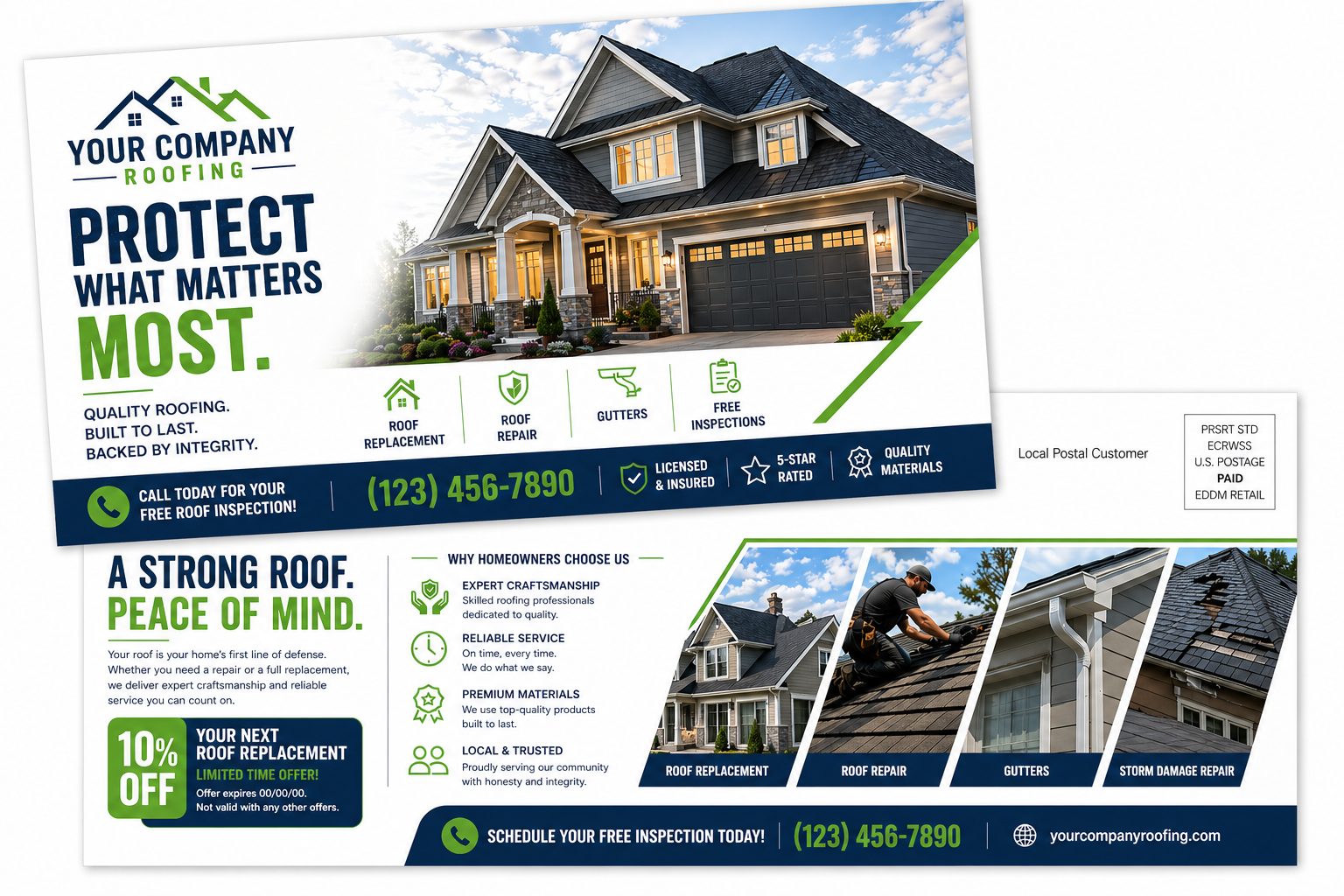
- EDDM Retail indicia — a specific block of text that replaces the stamp. It includes the words "ECRWSS" and "EDDM Retail." It sits in the upper right corner of the mailing panel side.
- Mailing address line — the area that would normally hold a recipient address. For EDDM, this reads "Local Postal Customer" or similar. No individual addresses are required.
- Clear space for the carrier route information and any USPS markings.
The other side (the "back") is yours for the offer. Most printers expect a 0.125" bleed and a 0.125" safe zone from the trim. Keep critical text and logos out of the safe-zone gutter on both sides.
For the exact dimensions, sample indicia block, and a template you can hand to your designer, see EDDM design guidelines and the dedicated EDDM indicia and mailing panel layout reference. If you are working in Canva or Adobe and want a starting template, mention that when you request a quote and we will send one.
EDDM postage in plain English
EDDM Retail postage is $0.247 per piece as of 2025 (current USPS published rate for EDDM Retail USPS Marketing Flats). It is a flat per-piece rate that does not change based on distance or quantity within EDDM Retail. The postage is treated as pass-through on the EDDM2GO invoice — USPS gets paid what USPS charges, and we add only a small handling fee tied to the work of preparing and dropping the mail.
If you have a USPS bulk mail permit and you are mailing high volume or recurring, BMEU rates are slightly lower (as low as $0.242 per piece per USPS), but require a permit. That route requires a permit, paperwork, and a regional BMEU facility drop-off. Most local businesses do not need it. See the full breakdown on the EDDM postage rates page and the side-by-side on EDDM Retail vs. BMEU.
| Postage path | Per piece | Permit? | Best for |
|---|---|---|---|
| EDDM Retail | $0.247 | No | Most local mailings under 5,000 per ZIP per day |
| BMEU (bulk) | As low as $0.242 per USPS | Yes | High-volume or recurring campaigns |
Route selection in one paragraph
A carrier route is the USPS delivery path one mail carrier walks or drives. Every address on that route gets your mailer — no targeting, no list. You pick routes on a map, see the household and business count on each route, and choose enough routes to hit your target quantity. EDDM Retail caps you at 5,000 pieces per ZIP code per day, so very large mailings either split across multiple drop days or move to BMEU. For the full method we use to pick routes (proximity, demographics, drive time), see the EDDM route selection guide.
Bundling and facing slips: what happens after print
After your job prints, the work is not done — USPS requires the mail to be prepared a specific way. This is the part that catches first-time DIY EDDM mailers off guard.
- Mailpieces must be separated by carrier route. Each route is its own physical bundle.
- Each bundle holds 50 to 100 pieces. Larger routes are split into multiple bundles.
- A facing slip (a printed USPS form identifying the route, drop date, and your contact info) sits on top of each bundle, held with a rubber band.
- The bundles are dropped at the destination post office that serves the selected routes, along with a USPS Form 3587 (or the EDDM Retail equivalent) and payment.
If you order full-service EDDM through EDDM2GO, we handle the bundling, facing slips, paperwork, and the post office drop. If you would rather do it yourself, the EDDM bundling and facing slips page walks through the exact steps and forms.
When to skip DIY: If your mailing is over about 2,500 pieces or covers more than three carrier routes, the time you spend bundling, filling out forms, and waiting at the post office window is usually more expensive than the full-service fee. Mid-size jobs are where the math flips.
EDDM Retail vs. BMEU: which fits your situation
EDDM Retail fits most local mailings. BMEU fits high-volume or recurring programs where the postage savings cover the permit and the operational lift. Here is the short comparison.
| EDDM Retail | BMEU | |
|---|---|---|
| Permit required | No | Yes (USPS bulk mail permit) |
| Per-piece postage | $0.247 | As low as $0.242 per USPS |
| Daily limit | 5,000 pieces per ZIP per day | None |
| Drop-off | Local post office serving the route | BMEU facility (regional) |
| Minimum | 200 pieces per route | 200 pieces per mailing |
| Best for | Small and mid local mailings | High volume or recurring |
The full breakdown — including when the permit pays for itself — is on EDDM Retail vs. BMEU. Short version: under 25,000 pieces a year, EDDM Retail almost always wins on simplicity even if the per-piece is higher.
Frequently asked questions
Does a 6" x 9" postcard qualify for EDDM?
Not reliably. The standard 6" x 9" sits under both the length threshold (11.5") and the height threshold (6.125"), so USPS can reject it as a non-flat. The fix is to design at 6.5" x 9", which clears the height rule by 0.375" and is accepted everywhere.
What is the largest size I can mail with EDDM?
The maximum is 15" long by 12" high by 0.75" thick, and the piece cannot exceed 3.3 oz. In practice, the largest commonly used format is 11" x 17" folded down to a mailable size, or a flat 9" x 12". Anything larger usually pushes you out of the EDDM Retail flat class.
Do I need a USPS permit for EDDM Retail?
No. That is the main reason EDDM Retail exists — it lets a small business mail to every address on a carrier route without holding a bulk mail permit. You do need to fill out a simple USPS form at the drop-off (or we handle it for you on full-service jobs).
Can I send EDDM to a specific household or demographic?
No. EDDM hits every address on the carrier routes you select. If you need to mail only homeowners with kids under 5, or only businesses in a specific industry, you want a Targeted Direct Mail list instead. We can quote either; ask if you are not sure which fits.
How long does an EDDM job take from order to drop?
Standard print turnaround is 2 to 4 business days after artwork approval, plus 1 to 2 business days for bundling and drop-off if we are running full-service. Rush options exist. USPS then delivers within roughly 2 to 5 business days of accepting the mail at the destination post office.
Get a quote or talk through your campaign
If you know the size and quantity you want, head to the EDDM quote and order page to see live pricing and pick your routes on a map. If you would rather have a quick call to walk through size, route count, and timing, reach Morgan and the team at (713) 300-0687 or cs@eddm2go.com. We run full-service EDDM nationwide.