Restaurants, retail stores and gyms use EDDM (Every Door Direct Mail) to put one clear offer in every mailbox on the carrier routes around the door, with no mailing list. At the time of writing, 5,000 6.5 x 9 postcards with Full Service cost $2,643.17 before sales tax, postage included. Here is when to mail, where, and what to print.
Why EDDM fits a storefront
A storefront competes block by block. A pizza place is up against the restaurant down the street, a boutique against the shop across the parking lot, a studio against the gym on the next corner. Most customers come from the few miles around you, and EDDM matches that: you choose the carrier routes (the path one mail carrier covers each day) around your location, and every address on them gets your card.
A postcard also reaches people who don't follow you online yet. That matters most at the moments a storefront needs new faces: an opening, a new menu or collection, a sale, a slow season you want to fill.
Campaigns that suit each type of storefront
| Business | Natural EDDM campaigns | Offer that brings people in (example copy) |
|---|---|---|
| Restaurants | Grand opening, new menu, delivery-zone announcement, slow weeknights | "Bring this card for a free appetizer" |
| Retail stores | Grand opening, holiday and clearance sales, new season's arrivals | "$10 off any $50 purchase, through the date on the card" |
| Gyms and studios | New year, openings, a spring program, early sign-up in late fall | "Bring this card for a free week" |
For an opening, plan one mailing that lands before the doors open and a second a few weeks after, so people who missed the first card hear about you again. For a sale, aim for the card to land about a week before it starts and print the end date. USPS does not guarantee EDDM delivery dates, so build a buffer before any fixed date.
Which routes to mail
- Closest routes first. The neighborhoods nearest the door are your core customers. Add a wider ring for openings and big events.
- Homes, businesses or both. A lunch spot or a lunchtime class may want routes with offices; a family restaurant or a toy store wants homes. The route map shows both counts for every route.
- Match your price point. A boutique studio or fine-dining room mails fewer, closer routes that fit its prices; a budget gym or quick-service chain mails wider.
- Delivery zones. A restaurant that delivers can mail the routes inside its delivery area, so the mailing follows the delivery map rather than a ZIP boundary.
You can see the homes on each route and the all-in price as you click, before you give any contact details. Saving a route list also earns the welcome credit: create an account, confirm your email and save a route list; it applies automatically to a first paid order within 60 days: $25 off, or $50 off at $500 or more (before tax and USPS postage).
Design: what to put on the card
- Lead with the offer. The deal or the free first visit, in large type, beats your logo as the headline.
- One strong photo. Your best dish, your best sellers, or real members (with written consent) rather than stock images.
- Hours and address, large. Some readers want to come in today.
- A QR code to the menu, the online store or the class schedule.
- Pick the size for the content. A 6.5 x 9 postcard fits one offer; an 8.5 x 11 flyer fits a short menu or a sale page. At the time of writing, 5,000 8.5 x 11 flyers with Full Service cost $2,678.16 before tax.
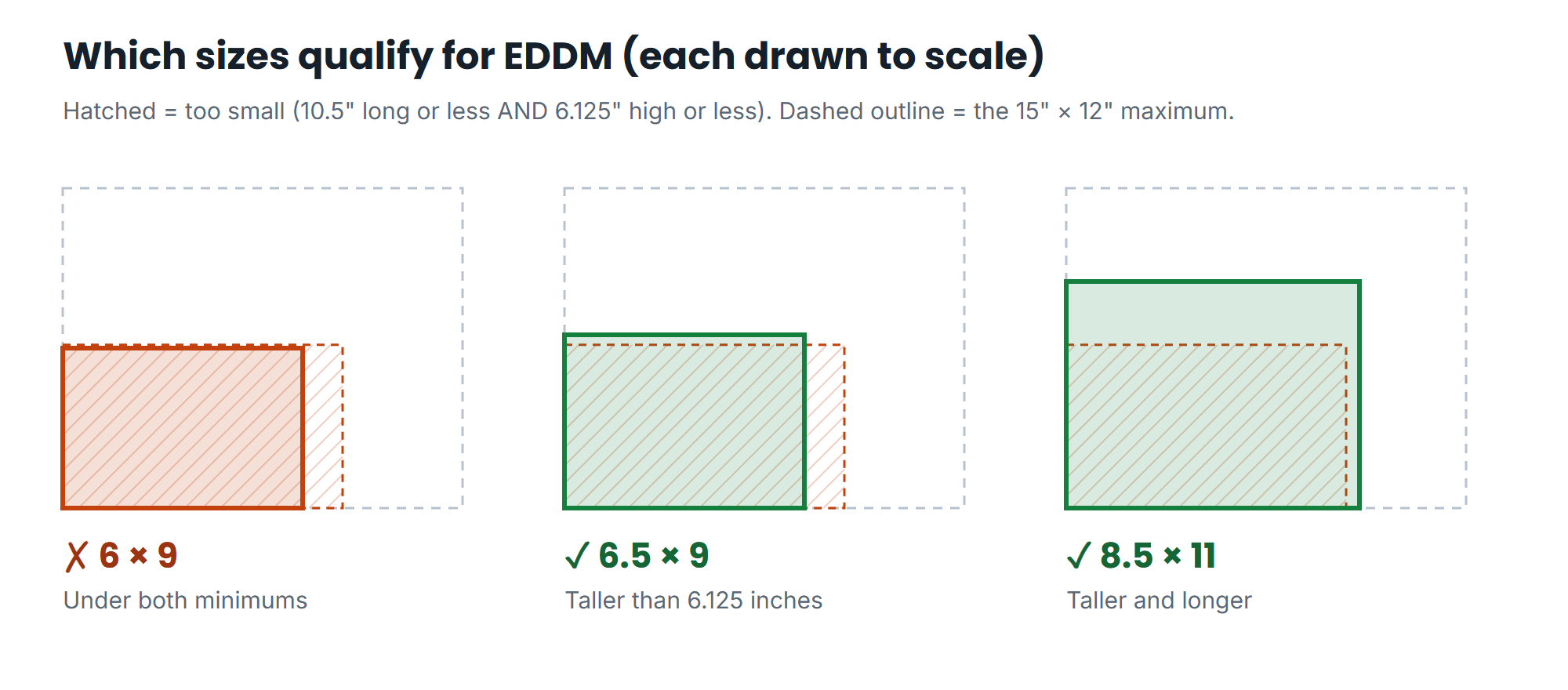
Our free EDDM templates come in every size and already leave room for the postage box. If you'd rather hand the design off, our design service is a flat $125.
What a storefront mailing costs
Real prices at the time of writing, before sales tax. Full Service includes printing, bundling by carrier route, USPS paperwork, delivery to the Post Office and postage, shown as its own line.
| 6.5 x 9 postcard | Full Service | Print Only (printing only) |
|---|---|---|
| 1,000 pieces | $748.52 ($0.75 each) | $386.74 |
| 2,500 pieces | $1,435.20 ($0.57 each) | $475.25 |
| 5,000 pieces | $2,643.17 ($0.53 each) | $688.36 |
A year of quarterly 5,000-piece mailings is 4 x $2,643.17 = $10,572.68 before tax. 8.25% sales tax is added at checkout on everything except USPS postage, in every state. With Print Only you get the printing; you pay USPS $0.26 a piece at the Post Office, plus shipping, and bundle the cards yourself. Today's figures are on the 6.5 x 9 Full Service page.
Break-even math (hypothetical)
Labelled arithmetic, not a prediction. The campaign in each case is 5,000 6.5 x 9 postcards with Full Service: $2,643.17 plus $107.59 sales tax = $2,750.76 all-in.
- Restaurant, $35 first-visit check: $2,750.76 ÷ $35 = about 79 tables, or roughly 1 in every 63 households on the routes, before any repeat visits.
- Boutique studio, $120 a month in dues: a member who stays 12 months brings $1,440. $2,750.76 ÷ $1,440 = about 1.9, so 2 year-long members cover the mailing.
- Budget gym, $15 a month: a year-long member brings $180. $2,750.76 ÷ $180 = about 15.3, so 16 year-long members cover it.
The lower the ticket, the more customers a mailing has to bring in and the more repeat visits matter. That is why low-ticket storefronts mail wider and more often. Run the same math with your own numbers; our post on whether EDDM works shows the full break-even method.
How to track what came back
- A bring-in card or coupon. Every card at the register is one confirmed response. Note the average ticket too.
- A unique promo code used only on this mailing, counted in your POS or online ordering.
- A QR code with a campaign link, so your analytics show the visits the mailing drove.
- Separate codes per route group, if you want to compare neighborhoods.
When EDDM is the wrong tool: if your customers are spread across a region rather than clustered near you, or you sell mainly online, a list-based mailing or digital ads will waste less. EDDM works when most households nearby could walk in.
Frequently asked questions
How much does restaurant direct mail cost with EDDM?
At the time of writing, 5,000 6.5 x 9 postcards with Full Service cost $2,643.17 before tax ($0.53 a piece), with printing, bundling, USPS paperwork and postage included. Smaller runs cost more per piece: 1,000 cards are $748.52. Current prices for every size are on the pricing page.
How far from my store should I mail?
Start with the routes closest to you, then widen the area for openings and big events. Look at homes per route on the map and grow outward from the door.
Can I mail only to homes and skip businesses?
Yes. You can choose residential addresses only, or include businesses on the routes.
When should a gym mail for the new year?
Order early enough that the cards can land around the turn of the year, and leave a buffer: you choose the production speed when you order, and USPS does not guarantee EDDM delivery dates.
Can EDDM reach only people who like my kind of business?
No. EDDM mails every address on a route; you choose the neighborhoods, not the people. That is why the offer has to appeal to anyone nearby.
Next step: see the homes on your routes and the price, free. More ideas by business type are on our industries page. Questions? Call (346) 306-EDDM (3336).