USPS carrier routes by ZIP code, explained with real route data
Every ZIP code is split into carrier routes, and every Every Door Direct Mail campaign is bought one route at a time. This guide shows how to look routes up for any ZIP code, read a route code, size a route and choose the right ones. The numbers come from 29,517 real routes in 65 cities across 26 states and Washington, DC, with a closer look at 5,128 routes around Houston.
By the EDDM2GO team · Updated October 25, 2026 · Route counts stored September 30 to October 13, 2026
Short answers
Carrier routes in four sentences
A carrier route is the set of addresses one USPS carrier delivers to. Each ZIP code holds several of them: across 1,452 ZIP codes in our data the middle one has 19, and in 63 of 65 cities the middle route reaches 500 to 800 homes. A route code such as 77494-C033 is the ZIP code, a letter for the route type and a 3-digit route number. Every Door Direct Mail (EDDM) is sold by the whole route, so routes are the unit you choose when you plan a mailing.
29,517carrier routes in 65 cities behind the numbers on this page
500 to 800homes on the middle route in 63 of the 65 cities
19routes in the middle ZIP code; half have 12 to 27
01 · Look them up
Find the carrier routes in any ZIP code
This works for any US ZIP code. Get a quick breakdown right here, then use the map when you want to pick routes, or the ZIP code page when you want to study them. No account for any of them.
Route breakdown for any ZIP code
Count a ZIP code's routes by type and size. Add a second ZIP code to compare the two side by side.
On the route map
Draws every route in the ZIP code on a map, with home and business counts. Click routes to select them and see your piece count.
On the ZIP code page
Lists every route in a sortable table, with an estimated income, homeowner and family profile for each, plus the ZIP code's demographics.
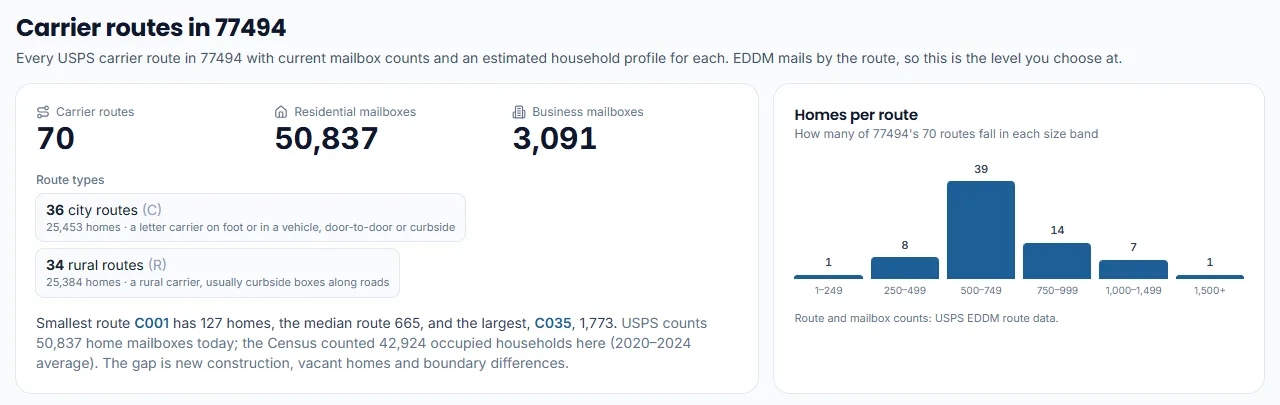
The top of the routes section on the 77494 ZIP code page: route count, mailboxes, route types and how big the routes are. Tap to enlarge.
02 · Route codes
How to read a carrier route code
A route code has nine characters. Once you can read one, a route list stops looking like a license plate collection.
77494ZIP code
CRoute type: city
033Route number
The route number only means something inside its ZIP code, so C033 in 77494 and C033 in 77493 are different streets. You will often see the code written without the dash (77494C033) in mailing software, or with just the last four characters (C033) when the ZIP code is already clear. The letters come from USPS mailing rules: its Quick Service Guide 203 lists C, R, H, B and G, each followed by a 3-digit number. USPS calls C a "carrier route"; it is the letter used for city delivery.
Letter
Route type
Who delivers it
C
City route
A city letter carrier, on foot or in a vehicle, door to door or curbside.
R
Rural route
A rural carrier, usually delivering to curbside boxes from a vehicle.
H
Highway contract route
A contractor hired by USPS, usually in outlying areas.
B
PO box section
Post Office boxes at a retail counter. No street delivery.
G
General delivery
Mail held at the Post Office for pickup.
Each type is explained in full in the next section, with real examples.
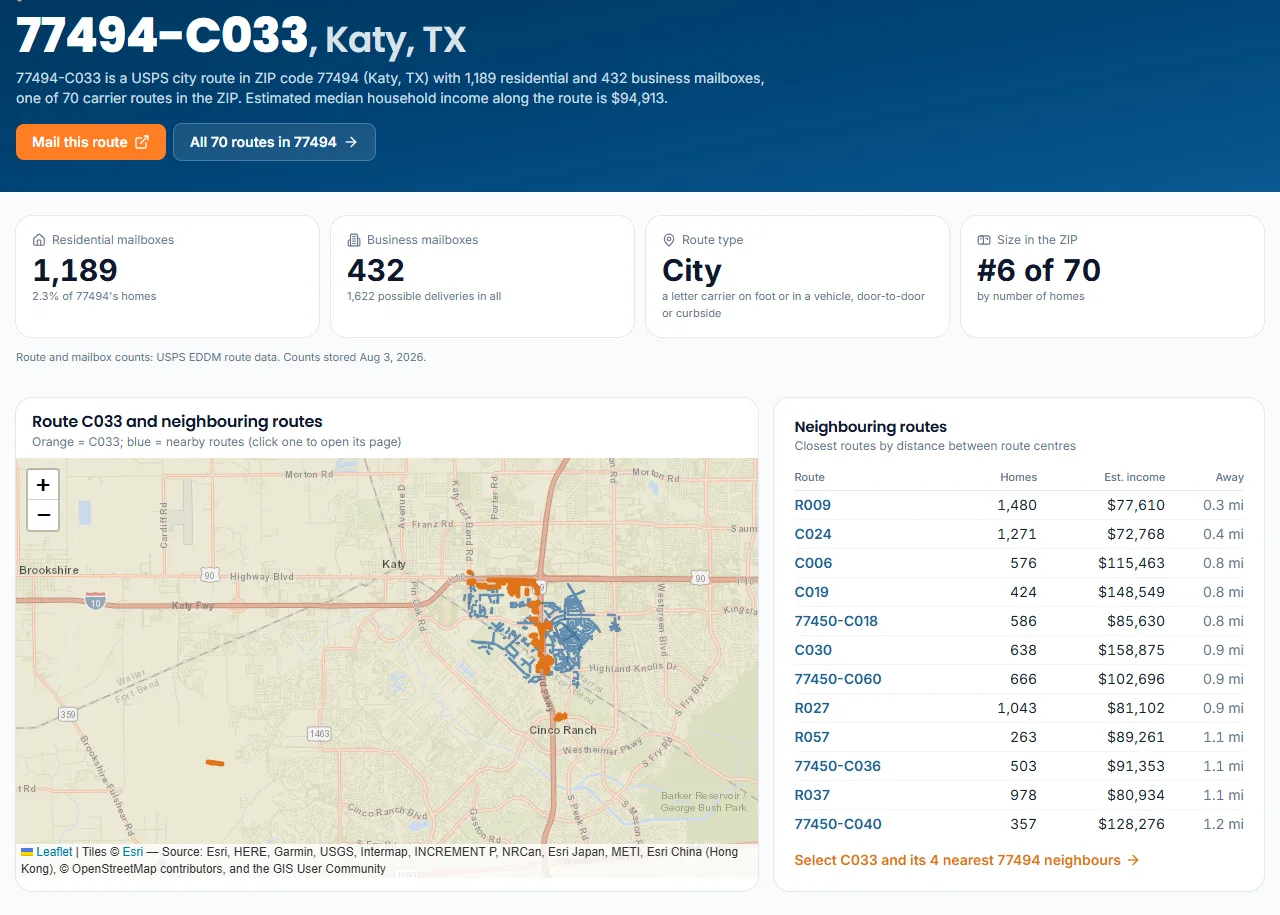
Each route has its own page on our site. Here is 77494-C033, a city route in Katy, Texas, with 1,189 homes and 432 businesses. It ranks sixth of the 70 routes in its ZIP code by homes.
A route page: mailbox counts, route type, size in the ZIP code and a map of the route with its neighbors. Tap to enlarge.
03 · Route types
The five carrier route types: C, R, H, B and G
The letter in a route code tells you how USPS delivers that route. It does not tell you what the neighborhood looks like, which is the part people miss. Here is each type: who delivers it, what the mailboxes look like, how common it is in our Houston-area data and what it means for a mailing.
C
C: City route
Most common
A city letter carrier, who works for USPS, delivers the route on foot, from a vehicle, or by parking and walking loops from the truck.
Mailboxes
Mail slots in doors, boxes by the front door, curbside boxes, and cluster mailboxes in apartment complexes and many newer subdivisions.
In our data
93% of the 29,517 routes in our 65-city data are city routes, and every one of Chicago's 1,785 routes is. Around Houston: 3,192 routes, 62% of the total. The middle city route has 628 homes and 29 businesses, the most businesses of any route type. 122 of the 314 ZIP codes have city routes only, such as 77002 in downtown Houston (23 routes) and 77450 in Katy (39 routes).
For your mailing
City routes run from downtown blocks to quiet suburban streets. Because they carry the most business addresses, they are where a business-to-business offer usually lands. On the route map, tick Include business addresses to add them to your count.
Route numbers
Numbered from C001. The highest in our Houston-area data is C104.
A rural carrier, who also works for USPS, delivers the route from a vehicle.
Mailboxes
Mostly curbside boxes the carrier reaches from the vehicle, plus cluster mailboxes in many newer neighborhoods.
In our data
Only 7% of the routes in our 65-city data, and most of those sit in fast-growing suburbs: every route in Cypress and Missouri City is rural, while Chicago, Atlanta and Baltimore have none. Around Houston: 1,888 routes, 37% of the total. The middle rural route there has 647 homes, slightly more than a city route, and 9 businesses.
For your mailing
Rural does not mean the countryside. Some of the Houston area's largest suburbs run entirely on rural routes: 77433 in Cypress (65 routes), 77084 in west Houston (54) and 77346 in Kingwood (47). In 77494, rural routes R035 and R039 are an estimated 98% homes built since 2010. A rural route takes the same mailer and the same EDDM postage as a city route, so judge it by who lives there, not by the letter.
Route numbers
Rural route numbers run higher. Our Houston-area data goes up to R401.
A contractor that USPS hires delivers the route. The carrier is not a USPS employee, but the mail and the rules are the same.
Mailboxes
Usually roadside boxes in outlying areas.
In our data
Just 24 of the 29,517 routes in our 65-city data. Around Houston: 48 routes, about 1% of the total, in 28 ZIP codes. The middle one has 464 homes and 8 businesses. Examples: 77327-H001 in Cleveland (1,021 homes) and 77331-H001 in Coldspring (913 homes). Katy's 77493 has 7 highway contract routes among its 38.
For your mailing
For Every Door Direct Mail, a highway contract route works like any other route. It shows up in the route list with its counts, and it takes the same mailer and the same postage.
Route numbers
Numbered from H001. The highest in our Houston-area data is H065.
A group of Post Office boxes inside a Post Office. People rent a numbered box and collect their mail there.
Mailboxes
PO boxes in the Post Office lobby. There are no houses and no streets on a B route.
In our data
Our Houston-area route data lists no PO box sections. Some ZIP codes are PO box only, set up just for a Post Office's boxes, so they have no delivery routes for homes at all.
For your mailing
A PO box section adds no homes to a mailing. The route map counts PO box routes on their own line, and our ZIP code pages leave out PO box sections that have no homes. If a ZIP code shows no routes, try the ZIP code where the homes are.
Route numbers
Numbered within the ZIP code, like the other types.
G
G: General delivery
No homes
Mail held at a Post Office for someone to pick up in person, usually a person without a permanent address yet, such as someone who just arrived in town.
Mailboxes
No mailbox. The mail waits at the Post Office counter.
In our data
Not in our route data. General delivery has no homes on a route.
For your mailing
General delivery plays no part in planning an EDDM campaign. You will rarely see a G code outside of postal paperwork.
Route numbers
Numbered within the ZIP code, like the other types.
Rural with highway contract, or city with highway contract
The short version for a mailing: C, R and H routes all take the same mailer, the same EDDM postage and the same rules. B and G add no homes. Pick routes by who lives on them, and treat the letter as background.
04 · Route size
How many homes are on a carrier route?
Here are the actual figures from 5,128 routes in 314 Houston-area ZIP codes in our USPS route data, counts stored August 3 to October 13, 2026.
Route type
Share of routes
Homes on the middle route
Most routes fall between
City route (C)
62%
628
329 to 1,125 homes
Rural route (R)
37%
647
431 to 962 homes
Highway contract route (H)
1%
464
156 to 697 homes
All delivery routes
100%
637
489 to 820 homes (the middle half)
"Most routes" is the 10th to 90th percentile for each type. Homes means residential mailboxes; businesses are counted separately and make up about 6.5% of all mailboxes in this data.
What this means for a mailing
Count in routes, not miles. About 1,000 pieces is one or two routes. About 5,000 pieces is usually six to ten.
Check the big ones. A few routes are far larger than the rest. The largest in this data, 77493-C033, reaches 5,200 homes. Before you add a large route, open its page and check owners, renters and types of homes.
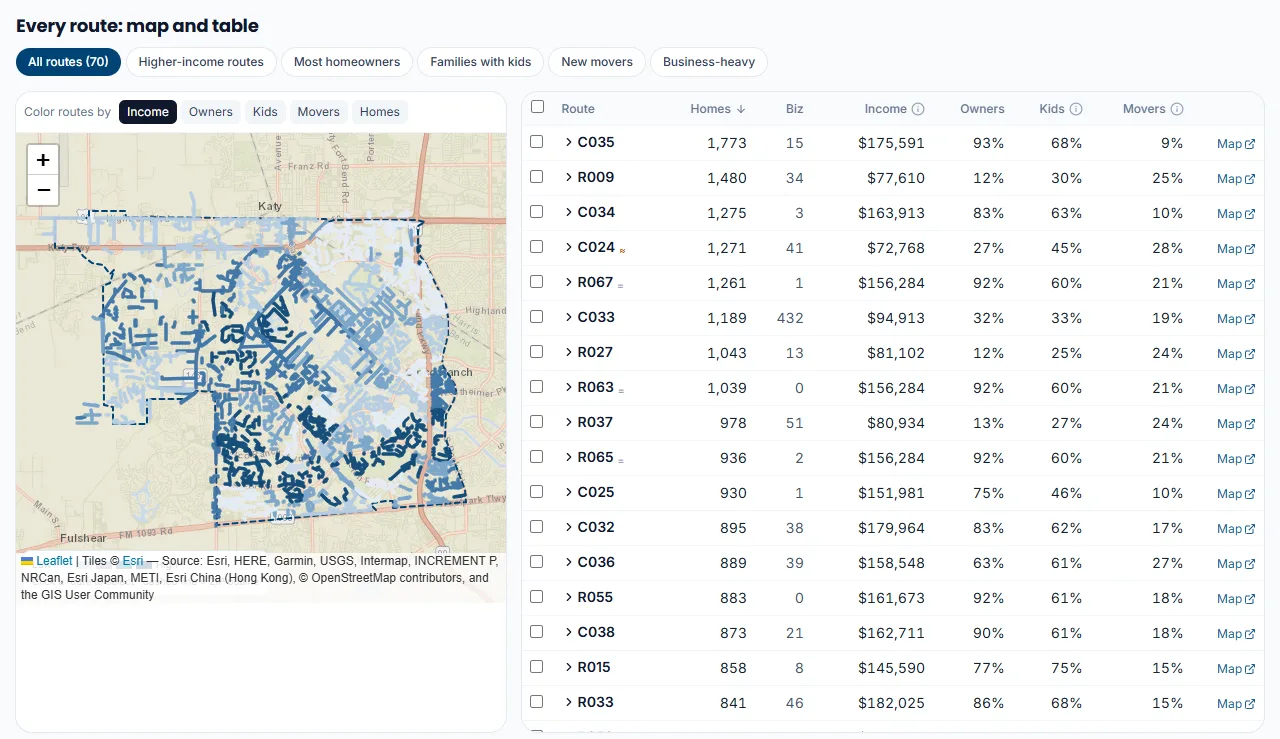
Small routes still cost a full route. The smallest route in 77494 has 127 homes. You mail all of them or none of them. To price a set of routes, try the quick ZIP code quote or see EDDM pricing.
Every route in 77494, sorted by homes. The map colors routes by estimated income; the table compares them side by side. Tap to enlarge.
05 · Across the country
Carrier routes in 65 cities, compared
Route sizes are surprisingly steady across the country. What changes from place to place is the route type. These are 29,517 routes in 65 cities across 26 states and Washington, DC, counts stored September 30 to October 1, 2026.
A typical route holds 500 to 800 homes. That is true of the middle route in 63 of the 65 cities. St. Louis has the smallest middle route (462 homes) and Conroe, TX the largest (815).
City routes dominate. 93% of these routes are city routes, including all 1,785 in Chicago.
Rural routes cluster in growing suburbs. Every route in Cypress and Missouri City is rural, while big older cities have almost none.
A bigger city just means more routes, not bigger ones. Count the homes on the routes you pick, not the size of the city.
Carrier routes by city: route count, homes on the middle route and route types. Select a column heading to sort.
Each city name opens its page in our EDDM service areas, with a map of its ZIP codes and its largest routes. Routes are counted by the city name USPS gives them.
06 · How they fit together
Carrier routes, ZIP codes and ZIP+4
Three ways USPS groups addresses, from big to small. Routes sit in the middle, which is why mailers use them.
Unit
What it covers
Typical size
Used for
ZIP code (77494)
A USPS delivery area made up of many carrier routes
About 9,900 homes in the middle Houston-area ZIP code in our data
Sorting mail; area-wide mailings
Carrier route (77494-C033)
The addresses one carrier delivers to
About 640 homes
Every Door Direct Mail; carrier route presort for addressed mail
ZIP+4 (77494-1234)
A small group of addresses, such as one side of a block or one building
ZIP code lines also don't tell you much about people. One ZIP code can hold apartments, retirees, new subdivisions and a business park. Routes are small enough to separate those, which is why we suggest choosing routes by who lives there, not by ZIP code lines.
07 · See them
Three ways to see carrier routes
Each one answers a different question. All three are free.
1. The route map: where are the routes, and which should I pick?
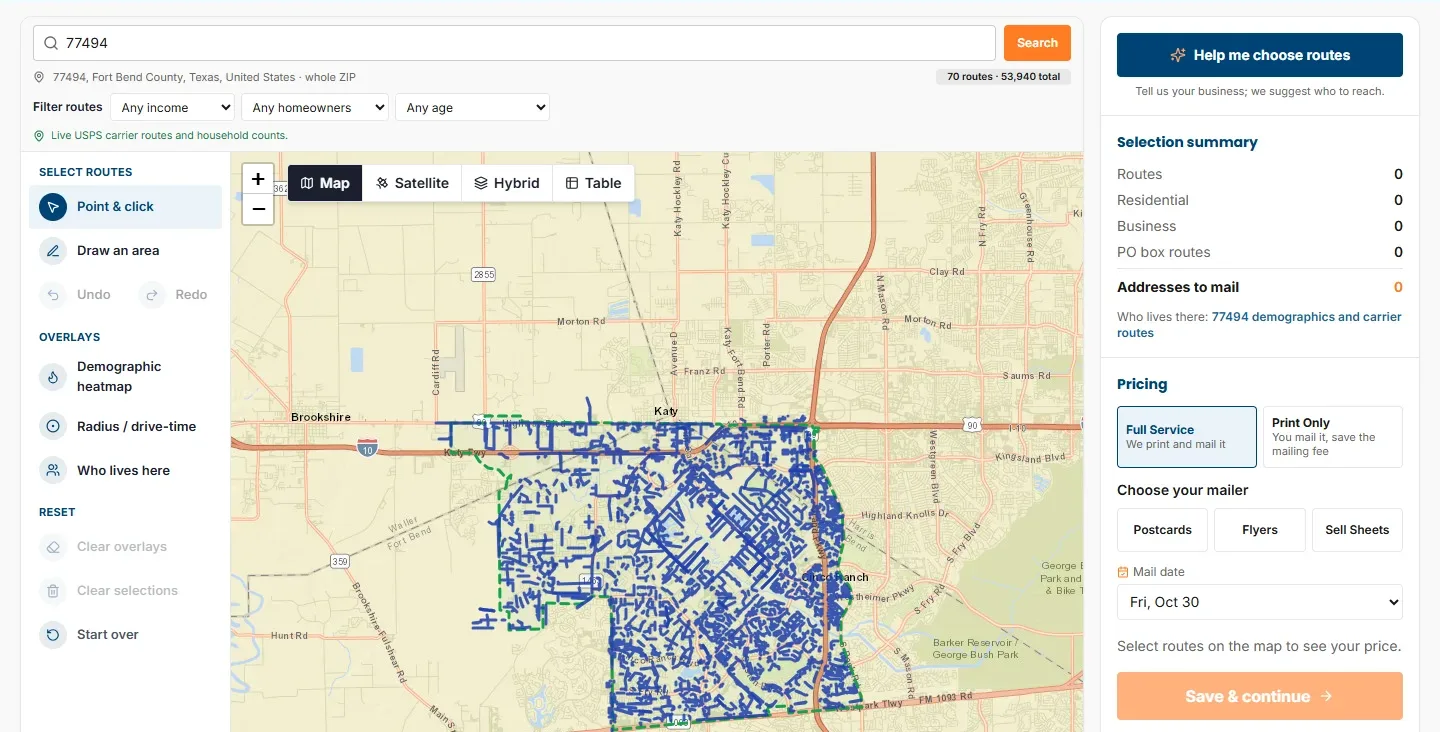
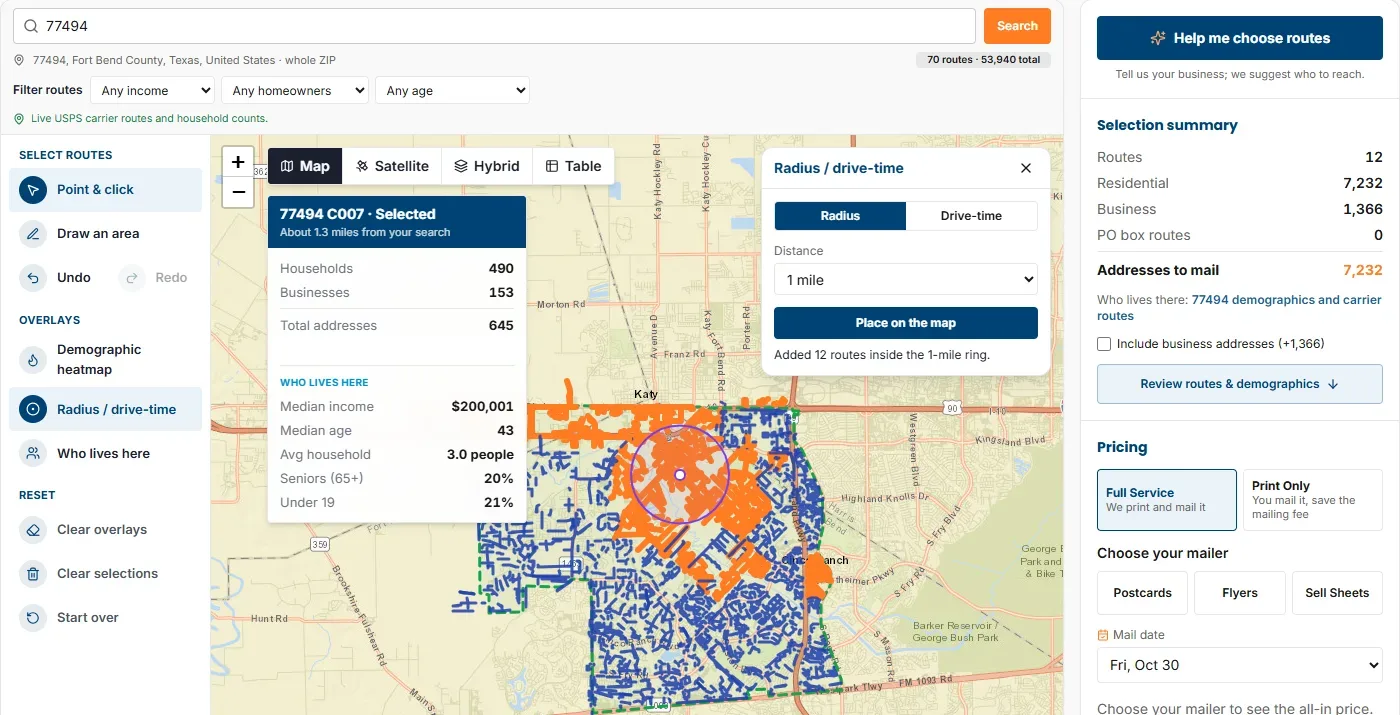
The EDDM route map draws every route in a ZIP code or around an address. Click routes to select them, filter by income, homeowners and age, or switch to a table. Your piece count updates as you go.
The route map after a ZIP code search. The route tool guide covers every feature. Tap to enlarge.
2. The ZIP code page: how do the routes compare?
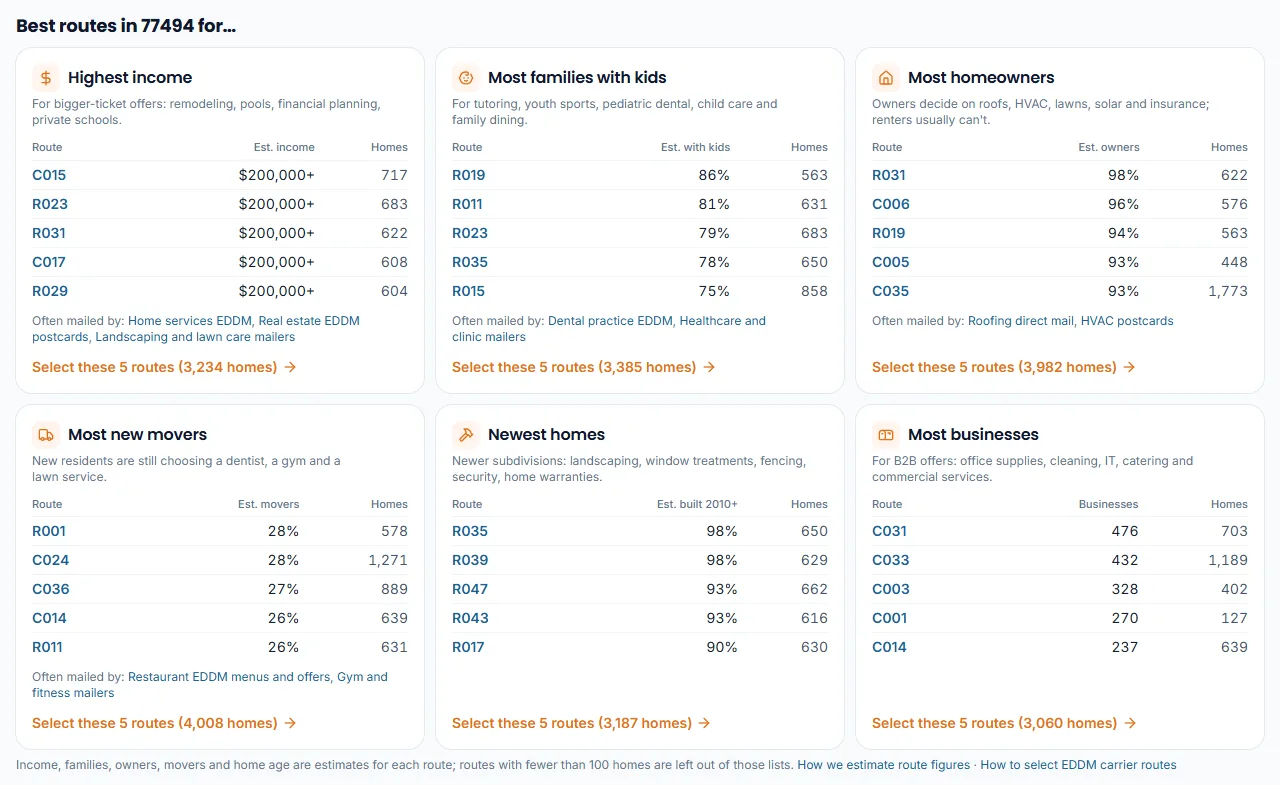
Each ZIP code page lists every route with its homes, businesses and an estimated profile. Its "Best routes for" cards rank routes by income, families with kids, homeowners, new movers, newest homes and businesses.
Ranked route lists on the 77494 page. Each card can select its five routes on the map. Tap to enlarge.
3. The route page: who lives on this one route?
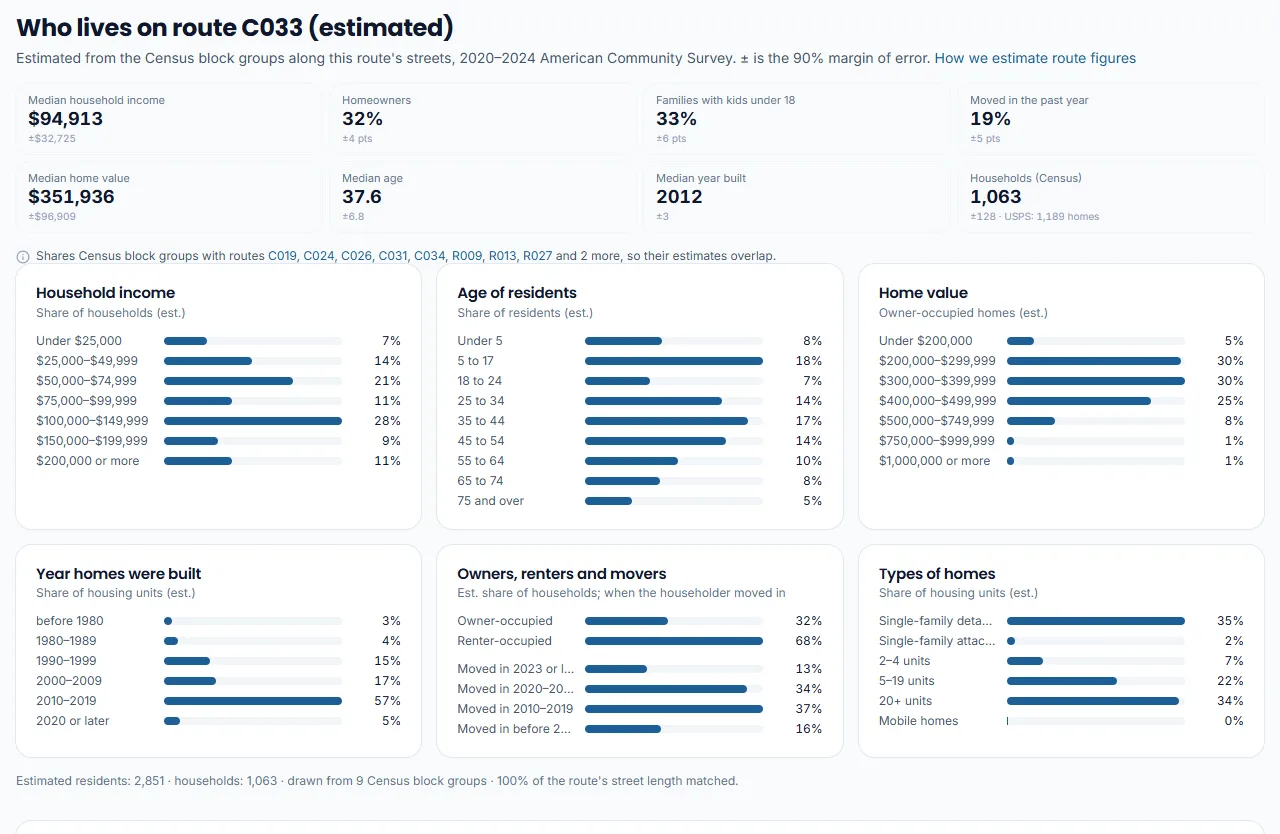
Every route page shows estimated household income, age, home value, year built, owners and renters, and types of homes along that route, with how it compares to its ZIP code.
The estimated profile for 77494-C033. These figures are modeled from Census data, not counted door to door. Tap to enlarge.
08 · One address
How to find the carrier route for an address
1
Search the address on the route map
Type the street address instead of a ZIP code. The map draws the routes within a set distance of it.
2
Click the route that covers it
A card opens with the route code, homes, businesses and who lives there.
3
Look at the neighbors
Your own route is rarely the only one worth mailing. The routes next to it are usually the same kind of neighborhood.
Click a route to open its card. This one shows the households, businesses and profile for that route. Tap to enlarge.
09 · Mailing by route
How Every Door Direct Mail uses carrier routes
EDDM is the USPS program for mailing every address on a route without a mailing list. The route is what you buy. USPS explains the program on its Every Door Direct Mail page, and our complete EDDM guide covers every rule.
Whole routes only. Your piece goes to every address of the type you choose on each route: every home, or every home and business. You can't pick streets inside a route.
No names or addresses. Pieces carry "Local Postal Customer" or "Postal Customer", so there is no list to buy.
The route sets the quantity. Add up the homes on your routes and that is your print run. Our route map does the math as you click, and the EDDM sizes page helps you choose the mailer.
USPS limits apply. For EDDM Retail, the kind you take to the Post Office yourself, USPS accepts up to 5,000 pieces per ZIP code per day.
Pieces are bundled by route. Each route's pieces are bundled with a facing slip that names the route. With Full Service we print, bundle by route, prepare the USPS paperwork and deliver the mailing to USPS. With Print Only you handle the facing slips, the USPS paperwork and the Post Office trip.
Need specific people, not whole routes? If you want to mail past customers or a list of homeowners over 55, a targeted, addressed mailing fits better than carrier routes. See EDDM vs. targeted direct mail.
10 · Choosing routes
Pick routes by who lives there
Mailing a whole ZIP code is the easy choice. But one ZIP code can hold very different neighborhoods, and route data shows the difference.
Farm the same routes every month so your name sticks.
Say you run a roofing company in Katy. In 77494, the "Most homeowners" card lists routes where an estimated 93% to 98% of homes are owner-occupied, while route R009 in the same ZIP code is an estimated 12%. Same ZIP code, very different mailbox. The route selection guide walks through the full process, and the route tool guide shows the filters that do it in a few clicks.
11 · The data
Where carrier route numbers come from
Route codes and mailbox counts come from USPS Every Door Direct Mail route data, the same counts behind the USPS EDDM route tool. Each route page shows the date its counts were stored. Route letters follow USPS Quick Service Guide 203.
Counts move. USPS adjusts routes as neighborhoods grow, so a route can gain homes, split in two or merge with another. Check counts again before a repeat mailing.
Demographics are estimates. Income, age, homeowners, families and movers on route pages are modeled from U.S. Census American Community Survey data along each route's streets. They are good for comparing routes, not facts about a household.
The national figures cover 29,517 routes in 1,452 ZIP codes in 65 cities, counts stored September 30 to October 1, 2026. The Houston close-up covers 5,128 routes in 314 ZIP codes starting with 77, counts stored August 3 to October 13, 2026. The lookup on this page reads current counts for any ZIP code.
12 · Questions
Carrier route FAQ
What is a USPS carrier route?
A carrier route is the set of addresses one USPS carrier delivers to. Every ZIP code is split into carrier routes, and each route has a code made of the ZIP code, a letter for the route type and a 3-digit number, such as 77494-C033.
How do I find the carrier routes in a ZIP code?
Enter the ZIP code in our free route map. It draws every carrier route in that ZIP code with its home and business counts, and needs no account. Our ZIP code pages list the same routes in a table with an estimated household profile for each one.
How many carrier routes are in a ZIP code?
It depends on how many addresses the ZIP code has. Across 1,452 ZIP codes in 65 cities in our route data, the middle ZIP code has 19 routes, half have between 12 and 27, and the range runs from 1 route to 70. The lookup on this page counts the routes in any ZIP code.
How many homes are on a carrier route?
Typically 500 to 800. In 63 of the 65 cities in our route data, the middle route has between 500 and 800 homes. St. Louis has the smallest middle route (462 homes) and Conroe, TX, the largest (815). A few single routes reach more than 5,000 homes.
What do the letters C, R, H, B and G mean in a route code?
They are the route type. C is a city route, R a rural route, H a highway contract route, B a section of PO boxes and G general delivery. The letter describes how mail is delivered, not how rural the area is.
What is a rural route (R)?
A rural route is delivered by a USPS rural carrier from a vehicle, mostly to curbside boxes and cluster mailboxes. Many suburbs run on rural routes: in our Houston-area data, every route in 77433 (Cypress) and 77346 (Kingwood) is a rural route. For EDDM, a rural route takes the same mailer and postage as a city route.
What is a highway contract route (H)?
A highway contract route is delivered by a contractor that USPS hires, not by a USPS employee. They are usually in outlying areas and are rare: 48 of the 5,128 Houston-area routes in our data. For EDDM they work like any other route.
What is a PO box section (B)?
A B route is a group of Post Office boxes inside a Post Office, not homes on a street. It adds no homes to an EDDM mailing. Our route map counts PO box routes on their own line, and our ZIP code pages leave out PO box sections with no homes.
Is there a carrier route lookup for any ZIP code?
Yes. The lookup on this page works for any US ZIP code: it counts the routes by type and size and can compare two ZIP codes side by side. Our free route map draws the same routes on a map, and USPS has its own EDDM route tool.
Can I get a free carrier route map or PDF?
Yes. Our route map shows carrier routes for any ZIP code for free. After you select routes, the review has a Print or save as PDF button that saves each route with its counts and demographics. Each ZIP code page also has a map of its routes.
How do I find the carrier route for my address?
Search the address in our route map. It draws the routes around that address, and the route that covers it is on the map. Click it to see its code and counts.
Do carrier routes change?
Yes. USPS adjusts routes as neighborhoods grow and delivery needs change, so routes are added, split or merged and their counts move. Our route pages show the date their counts were stored.
What is the difference between a carrier route and ZIP+4?
A carrier route is a whole delivery route of hundreds of addresses. A ZIP+4 code narrows a ZIP code to a small group of addresses, such as one side of a block or one building. Every Door Direct Mail is bought by the carrier route, not by ZIP+4.
Can I mail only part of a carrier route?
Not with Every Door Direct Mail. EDDM goes to every address of the type you choose on each route: every home, or every home and business. To reach fewer people, choose fewer or smaller routes.
Are carrier route demographics exact?
No. Mailbox counts come from USPS. Income, age, homeowners and similar figures on our route pages are estimates built from Census data along each route's streets. Use them to compare routes, not as facts about any one household.
More answers about ordering, files and mailing dates are in our EDDM FAQ. Checking your artwork? Try the free EDDM file checker.