Size guide
EDDM sizes and requirements
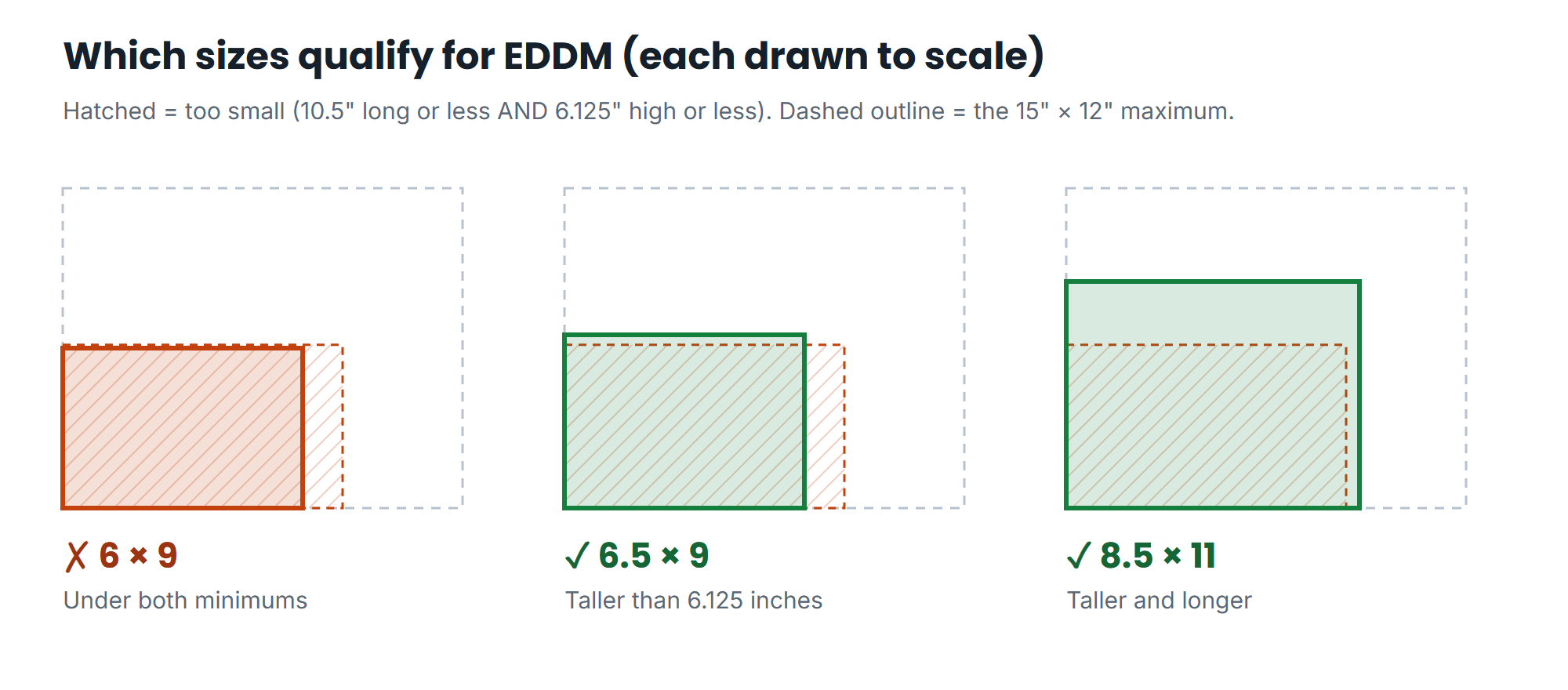
An EDDM piece must be a flat: longer than 10.5", taller than 6.125" or thicker than 0.25", and no larger than 15" × 12" × 0.75" or 3.3 oz. That rules out 6 × 9 and 4 × 6 postcards; 6.25 × 9 and 6.5 × 9 qualify.
The USPS size rules for EDDM
USPS measures length along the longest side and height across it. A piece has to clear at least one minimum and stay inside every maximum.
| Measure | Must be more than (any one) | Must be no more than | USPS source |
|---|---|---|---|
| Length (longest side) | 10.5" | 15" | DMM 143.2.5 · DMM 101.2.1 |
| Height | 6.125" (6-1/8") | 12" | DMM 143.2.5 · DMM 101.2.1 |
| Thickness | 0.25" | 0.75" | DMM 143.2.5 · DMM 101.2.1 |
| Weight | No minimum | 3.3 oz | DMM 143.2.5 |
The general USPS flat definition uses 11.5 inches for length; EDDM Retail has its own 10.5-inch rule, which is why 4.25 × 11 and 6.25 × 11 pieces qualify. Rules quoted from the USPS Domestic Mail Manual (DMM); follow the links for the full text.
Every EDDM size we print, drawn to scale
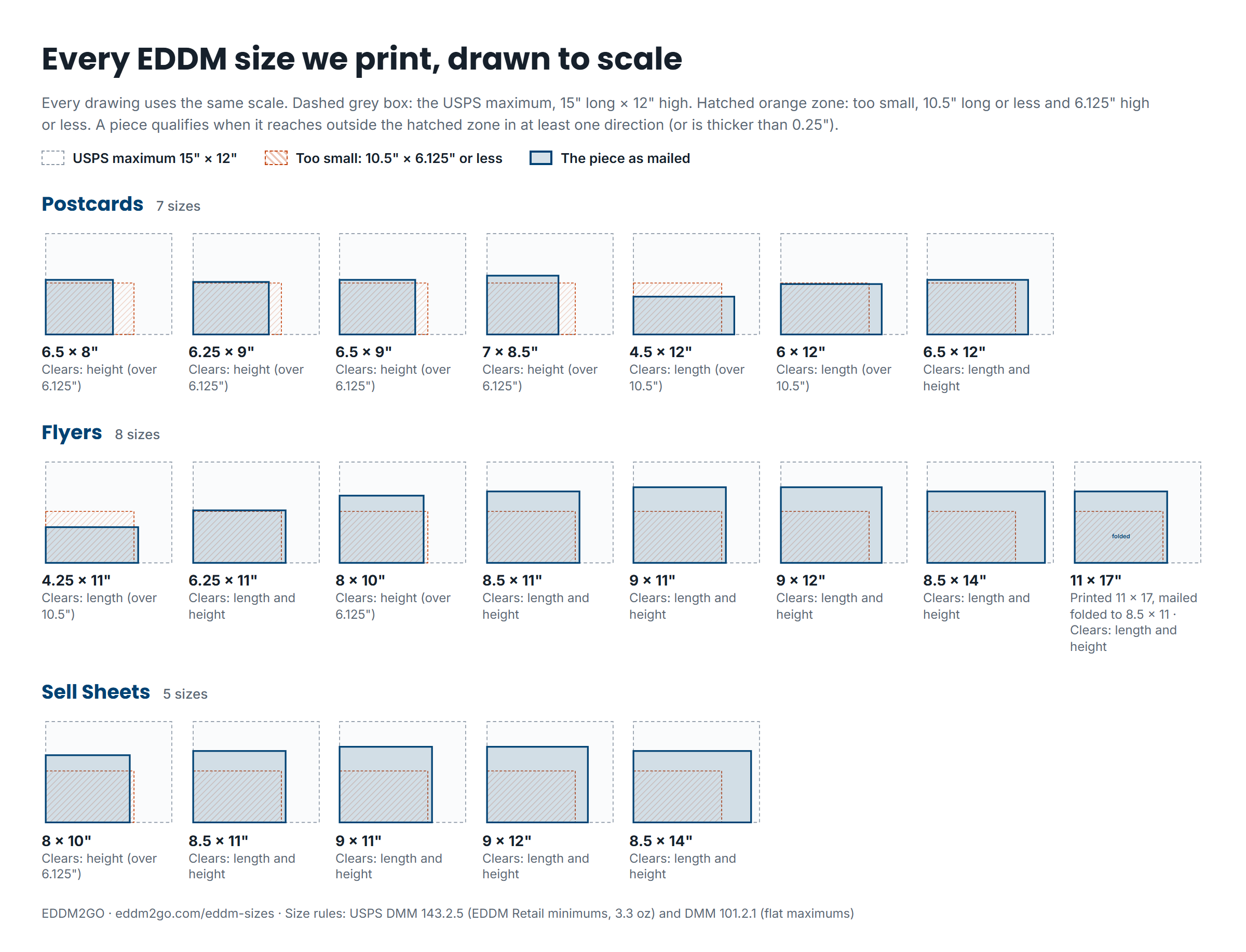
Every drawing uses the same scale. Dashed grey box: the USPS maximum, 15" long × 12" high. Hatched orange zone: too small, 10.5" long or less and 6.125" high or less. A piece qualifies when it reaches outside the hatched zone in at least one direction (or is thicker than 0.25"). 15 sizes across postcards, flyers and sell sheets.
Postcards · 7 sizes
Flyers · 8 sizes
- 4.25 × 11"Clears: length (over 10.5")
- 6.25 × 11"Clears: length and height
- 8 × 10"Clears: height (over 6.125")
- 8.5 × 11"Clears: length and height
- 9 × 11"Clears: length and height
- 9 × 12"Clears: length and height
- 8.5 × 14"Clears: length and height
- 11 × 17"Printed 11 × 17, mailed folded to 8.5 × 11 · Clears: length and height
Sell Sheets · 5 sizes
Every size, the rule it clears and what it costs
Full Service prices for 1,000 pieces mailed: printing full colour both sides, bundling by carrier route, USPS paperwork and postage. Your routes set the exact count. + sales tax (8.25%, not on postage).
Standard production · prices updated Oct 2 · Print Only prices are on each size page and on the pricing page.
Which size fits your offer
Start from what the mailer has to say, not from the biggest size. Postage is the same per piece for every size here, so the choice is about room and printing cost.
One offer or a coupon
The smallest sizes that clear the USPS height rule. Room for one headline, one photo and one phone number, which is all most first mailings need.
A menu or a price list
Long, narrow pieces read top to bottom like a menu board. 4.5 × 12 is a slim panel; 8.5 × 14 gives a full legal-length page.
Several services or offers
A full letter page per household: a service list, a few coupons, a map and your reviews on one sheet.
Photos that sell (before-and-after, listings)
Photo-print proportions and the most face per piece. 9 × 12 clears both USPS rules and is hard to miss in a stack of mail.
A wide, panoramic look
Twice the face of a standard postcard, with headline room across the full 12-inch length.
A folded brochure feel
Printed 11 × 17 and folded to 8.5 × 11 for the mail, so you get several panels: a cover that sells, inside panels for the detail.
Bleed, safe zone and the mailing side
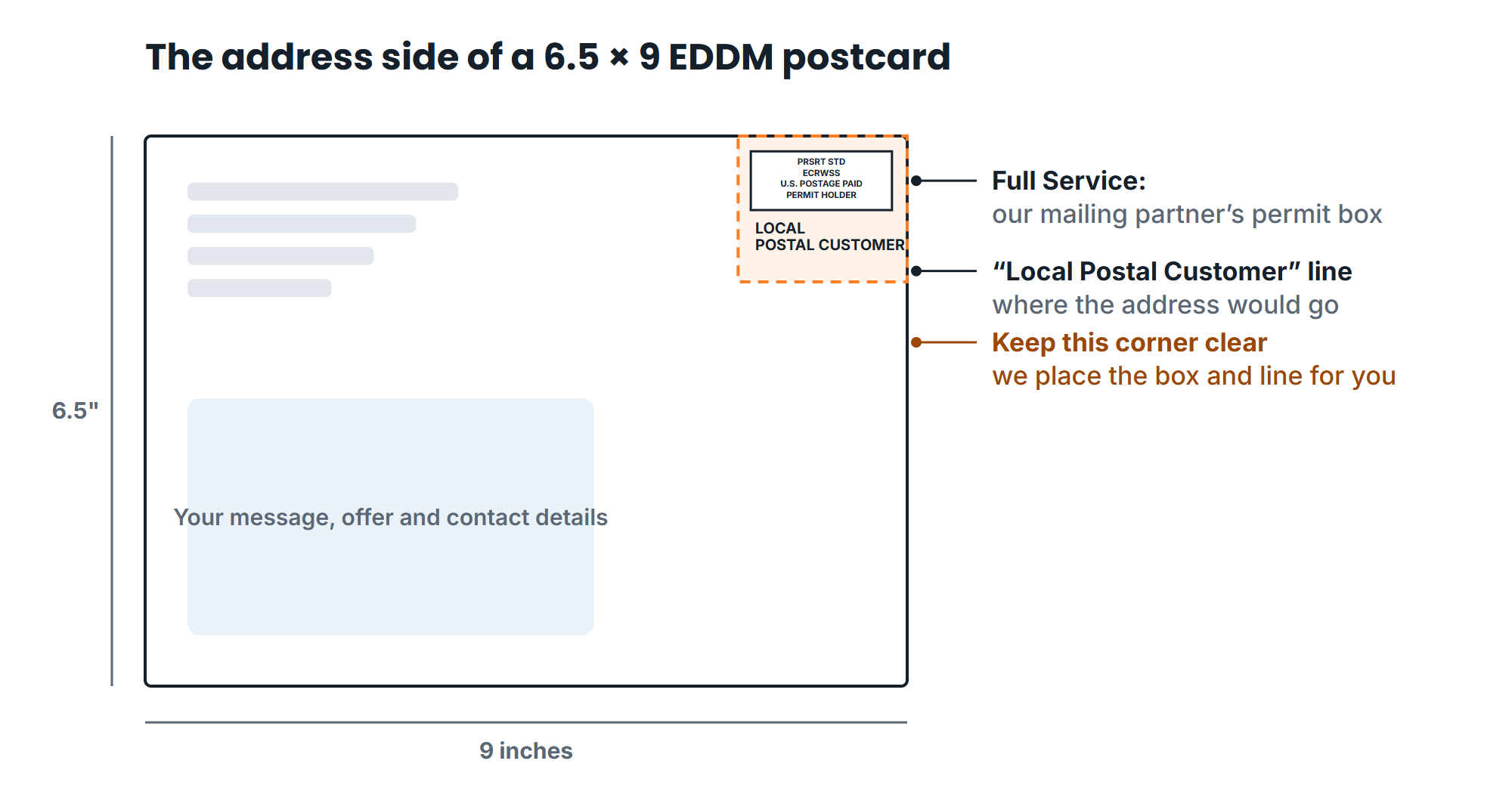
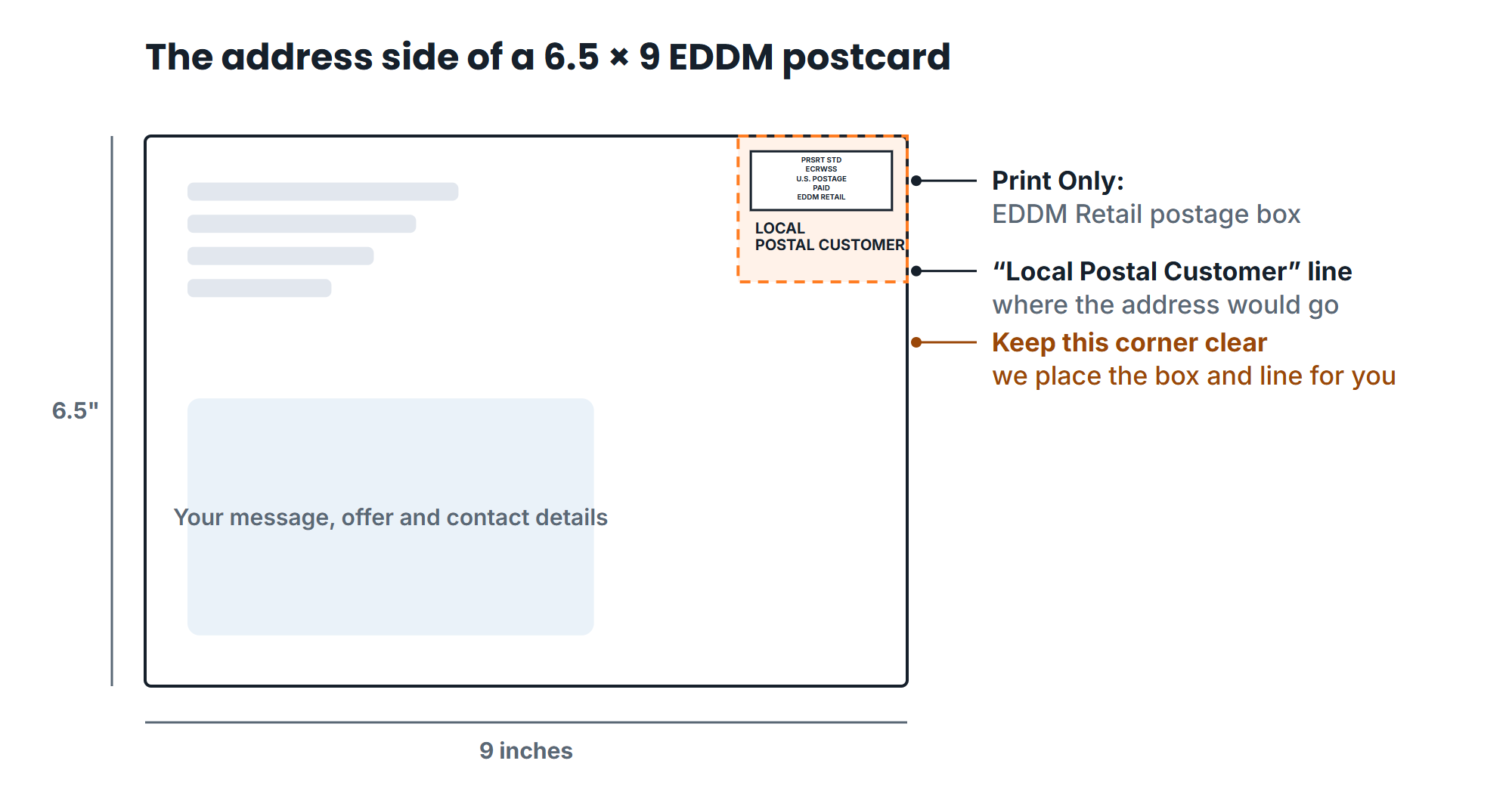
Every size follows the same three file rules: 0.125" (1/8") of bleed on each edge, text and logos at least 1/8" inside the trim, and a clear top-right corner on the mailing side for the postage box and the "Local Postal Customer" line.
Full file setup guide · Free templates for every size (bleed, trim, safe zone and indicia already placed)
EDDM size questions
What size does an EDDM postcard have to be?
It has to qualify as a flat: longer than 10.5 inches, taller than 6.125 inches, or thicker than 0.25 inch. It only has to clear one of the three. It also cannot be bigger than 15 × 12 inches or 0.75 inch thick. The most common EDDM postcards are 6.25 × 9 and 6.5 × 9, which qualify by height.
What is the minimum size for EDDM?
There is no single minimum rectangle. A piece qualifies once it is longer than 10.5 inches OR taller than 6.125 inches OR thicker than 0.25 inch (USPS DMM 143, section 2.5). So 6.25 × 9 qualifies by height and 4.25 × 11 qualifies by length.
What is the maximum size for EDDM?
15 inches long, 12 inches high and 0.75 inch thick (USPS DMM 101, section 2.1), and no more than 3.3 ounces for EDDM Retail (DMM 143, section 2.5). An 11 × 17 piece is too long flat, which is why it is folded to 8.5 × 11 before mailing.
Can I send a 6 × 9, 5 × 7 or 4 × 6 postcard with EDDM?
No. A 6 × 9 card is 9 inches long (under 10.5) and 6 inches high (under 6.125), so it misses the height rule by one-eighth of an inch. 5 × 7 and 4 × 6 are letters. Moving up to 6.25 × 9 or 6.5 × 9 fixes it for little extra paper.
How much can an EDDM piece weigh?
Up to 3.3 ounces for EDDM Retail. A single postcard or flyer on 100 lb gloss cover or 16pt stock is well under that; weight only matters for heavy multi-page pieces.
Does a bigger size cost more postage?
No. EDDM Retail postage is one flat rate per piece for any qualifying flat up to 3.3 ounces ($0.26 per piece at the time of writing). A bigger size costs more to print, not more to mail. Compare the printing difference in the size table above or on the pricing page.
What bleed and safe zone does an EDDM file need?
Add 0.125 inch (1/8 inch) of bleed on every edge and keep text, logos and phone numbers at least 1/8 inch inside the trim. On a 6.5 × 9 card that means a 6.75 × 9.25 inch document and a 6.25 × 8.75 inch safe area. The free file checker measures this for you.
Where does the address and postage go on an EDDM piece?
On the mailing side, in the top-right area: the postage indicia box and the "Local Postal Customer" line. Keep that corner clear of artwork. With Full Service we place both for you; the free templates show exactly where they sit for each size.
More on the whole program in the EDDM guide, and every price by size and quantity on the pricing page.
Picked a size? Pick your routes.
See every USPS carrier route around your ZIP code with its home and business counts, then choose the mailer and see the itemised price before you pay.