One dental office has one neighborhood. Three offices have three, and they rarely behave alike. One is booked out for weeks, one just opened with empty chairs, and one sits close enough to another that their patients overlap. Mailing all three the same way is like ordering one size of scrubs for the whole staff: it fits somebody.
For a multi-location dental practice, Every Door Direct Mail works best when each office mails its own carrier routes, with a card that carries that office's address, phone number and offer, and a budget set by what that office needs. Here's how to map each office's area, keep offices from mailing the same homes, split the budget and measure each location on its own.
How do you map each office's area?
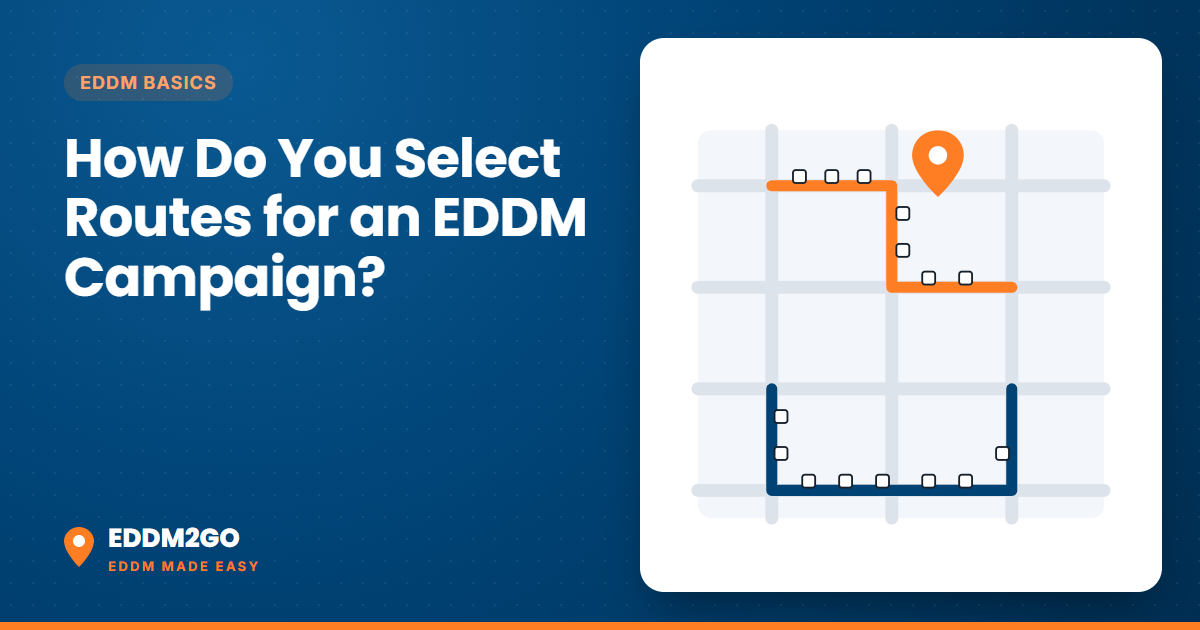
Search each office's address on a route map and draw a radius of 1 to 5 miles around it. The carrier routes inside that ring are that office's market.
EDDM (Every Door Direct Mail) is the USPS program that delivers a postcard to every address on the carrier routes you choose, with no mailing list. A carrier route is the set of addresses one mail carrier delivers to, usually 500 to 800 homes. Most patients look for a dentist near home, so the ring of routes around each office is where its patients live.
On our route map, the radius tool selects the routes inside the ring and counts their homes and businesses. Write down each office's routes before you plan anything else. Our route tool guide shows every step with screenshots.
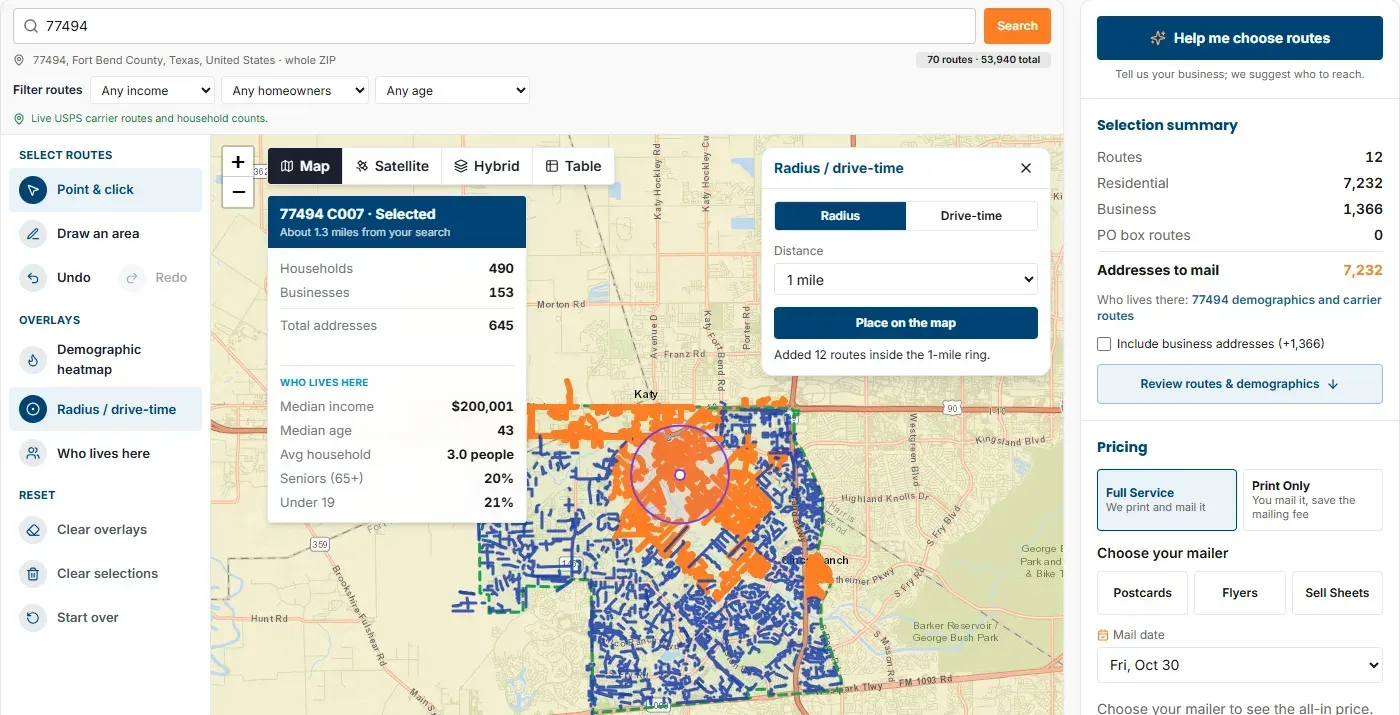
Then look at who lives on those routes. Our ZIP code pages list each route with estimated families with kids, new movers and homeowners, and our route-by-route guide for dental offices explains which numbers matter for which kind of practice. For a fast first pass, run our smart ZIP quote once per office: choose Dental, and it suggests routes, shows who lives there and prices the mailing.
How do you keep two offices from mailing the same homes?
Give every route that falls inside two offices' rings to the closer office, and take it off the other office's list. Otherwise the homes in the middle get two cards from the same practice with two different addresses, which costs twice and makes the brand look disorganized.
Do it once on paper and keep the list. When you mail again, each office mails its own routes and nobody gets the duplicate.
Should each office get its own card?
Usually, yes. A card for one office tells patients exactly where to go, while a card that lists five addresses makes them do the work. Keep the design the same across locations and change only the local details:
- Office address and a small map, so the reader can picture the drive.
- That office's phone number, ideally a tracking number used only on this card.
- That office's dentists, with a photo, because people book a person as much as a practice.
- Hours and insurance taken at that location, if they differ between offices.
- The offer, which can differ by office (see the budget section).
Each mailing carries one design. So plan each office's mailing separately, with its own routes and its own card. If you'd rather mail one card that lists every location, one mailing can cover routes around all of them, even across ZIP codes, but you lose the ability to tell which office the mail helped.
How should a dental group split its mail budget?
Split it by what each office needs, not evenly. New offices and offices with open chairs get more, and offices that are booked out get less.
| Office | What it needs | How we'd mail it |
|---|---|---|
| Newly opened | Awareness: nobody knows it's there | The most routes and the most mailings, starting before opening day |
| Open chairs on the schedule | New patients now | The closest routes with the most families and new movers, mailed on a steady schedule |
| Booked out for weeks | Staying known | Fewer routes, mailed less often, or a pause until there's room |
| A new service, such as clear aligners or implants | The right households | Routes with more homeowners or families, with a service-specific offer |
As a price guide, 2,500 6.5 x 9 postcards with EDDM Full Service are about $1,470 with USPS postage included, and 5,000 are about $2,710 (our prices on October 25, 2026). Three offices at 2,500 cards each is about $4,410 for one round. Sales tax is added at checkout; USPS postage is never taxed. Each office's routes set its exact count.
How do you market a new dental location?
Mail its routes three times: a few weeks before opening, around opening week and a few weeks later. Nobody on the surrounding streets has heard of a new office yet, so plan backward from opening day.
- Pick the routes within a short drive and assign any that overlap your other offices.
- Mail the first card a few weeks before opening, with the opening date and a reason to book early.
- Mail again around opening week, and a third time a few weeks later, to the same routes.
USPS doesn't guarantee EDDM delivery dates, so leave room. Choose your production speed at checkout, and you'll see your mail date before you pay. Plan from the week you want the card in mailboxes, then work backward.
How do you track results for each office?
Give each office's card its own phone number, QR code or offer code. Then count new-patient calls and bookings per office and divide each office's mailing cost by the patients it brought in. That cost per new patient tells you where the next round of budget should go. If you can't tell which office the mail helped, the campaign isn't finished. Nobody can promise a response rate, including us, so measure your own.
When is EDDM the wrong tool?
When you want to reach specific people, such as past patients. EDDM reaches every address on a route, so it can't reach only your past patients, only people over 55 or only one employer's staff. For patient reactivation, mail your own patient list as addressed mail. For lists of specific households, we quote targeted direct mail by phone or email. The two work well together: EDDM to find new patients near each office, addressed mail to bring existing ones back.
Frequently asked questions
Can one mailing cover several dental offices?
Yes, if every office gets the same card. One mailing carries one design and can include routes in several ZIP codes. If each office has its own address, phone number or offer on the card, plan a separate mailing for each office.
How do we keep two nearby offices from mailing the same homes?
Map each office's routes first. Give every route that appears on both lists to the closer office, and remove it from the other list.
Should every office get the same budget?
Usually not. Spend more where chairs are open or an office is new, and less where the schedule is already full.
Do the route numbers cover our markets outside Texas?
Home and business counts from USPS cover every route in every ZIP code. Our estimated route profiles, such as families with kids and new movers, cover Texas ZIP codes today.
Is there help planning several offices at once?
Yes. Call us and a real person will help you map each office's routes and plan the rounds. A real person also reviews every order before it prints.
Start by mapping your first office: search its address on the route map, set a radius and see the homes and the price, free, before you give us any contact details. Planning several locations? Call (346) 306-EDDM (3336).