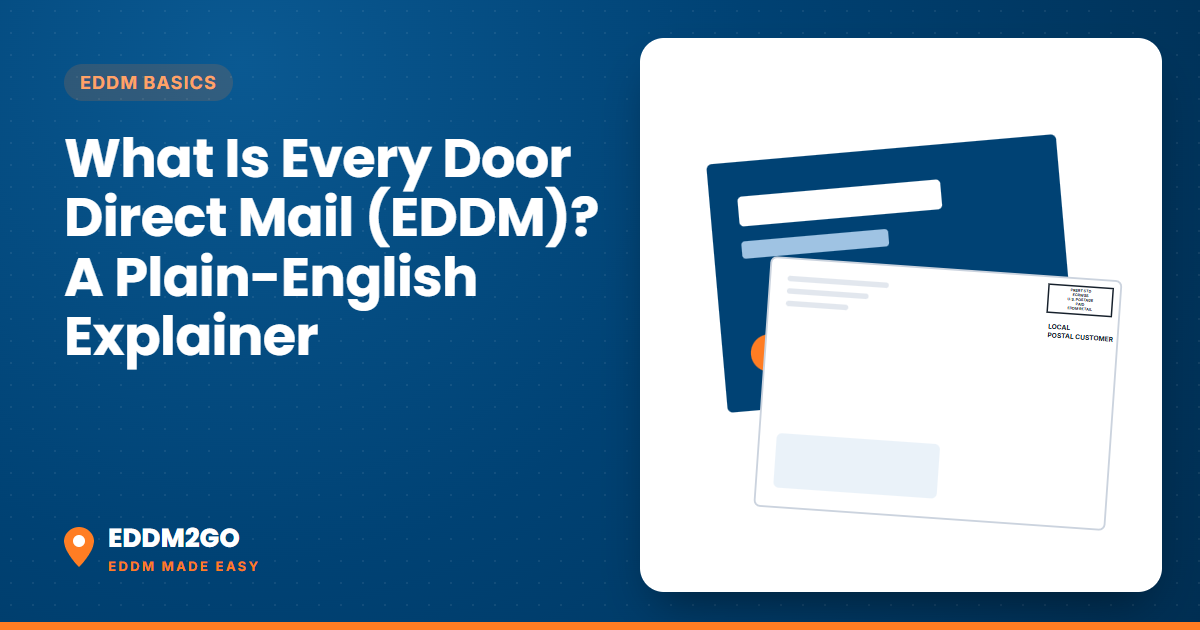
USPS EDDM, short for Every Door Direct Mail, is a USPS program that delivers your postcard or flyer to every address on the carrier routes you choose, with no mailing list and, for EDDM Retail, no mailing permit. You pick the neighborhoods. USPS puts one piece in every mailbox there.
You've probably pulled one out of your own mailbox: a pizza menu or a roofer's postcard with no name on it, just "Postal Customer." Here's how EDDM works, what it costs, the rules your mailer has to follow, and how to tell whether it fits your business.
EDDM at a glance
- What it is: a USPS Marketing Mail program for flat mailpieces, such as large postcards, flyers and menus.
- Who gets it: every address on each carrier route you choose. You can mail homes only, or homes and businesses.
- Addressing: no names or street addresses. Pieces say "Postal Customer" or "Local Postal Customer."
- Postage: $0.26 a piece for EDDM Retail flats up to 3.3 oz, according to the USPS EDDM page (checked October 25, 2026).
- Limits: EDDM Retail takes at least 200 and up to 5,000 pieces per ZIP code per day.
- Permit: none needed for EDDM Retail.
How does EDDM work, step by step?
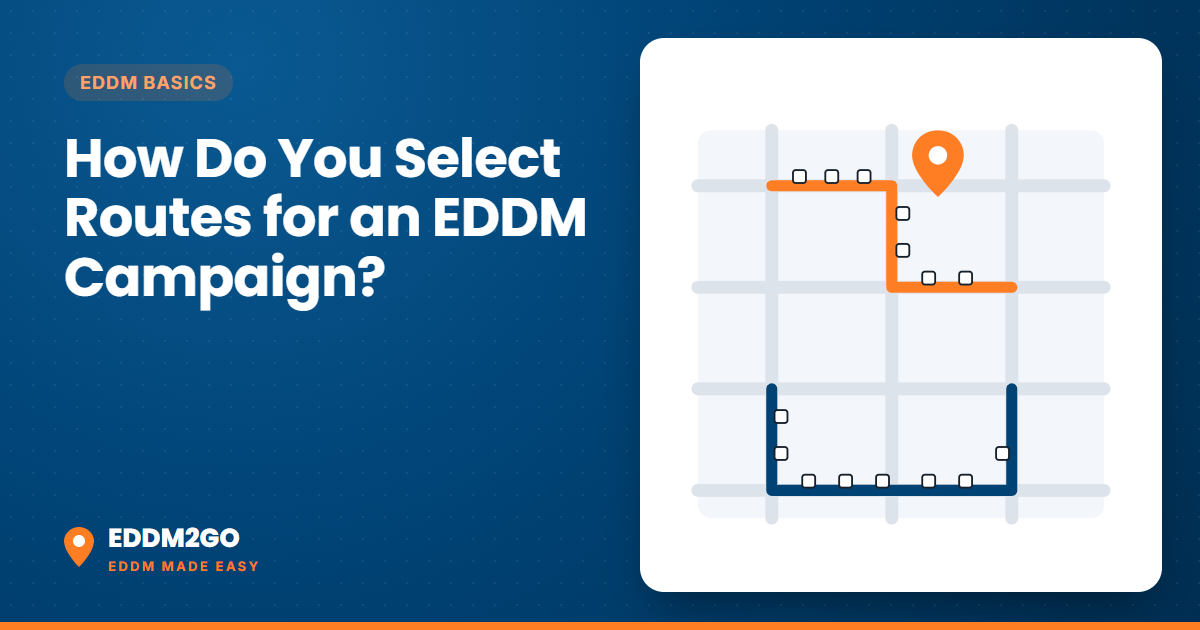
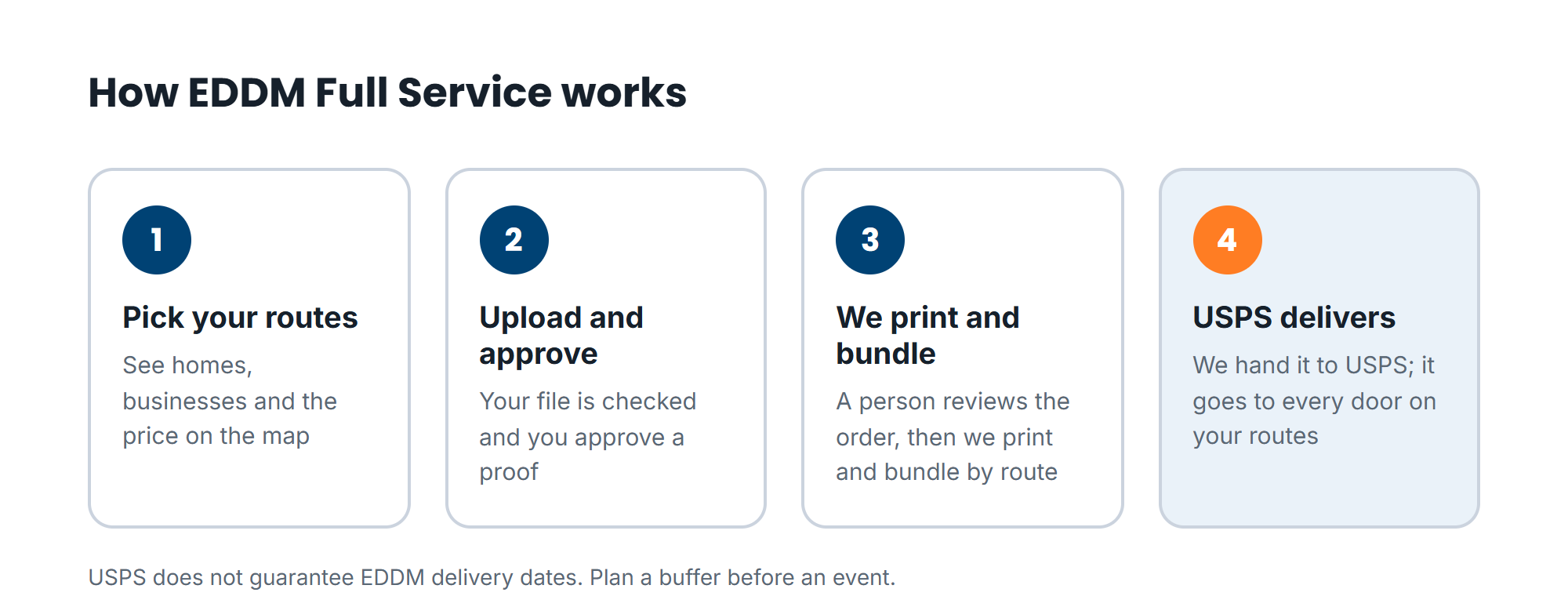
- Pick your carrier routes. Search a ZIP code or address on a route map and click the routes you want. Each route shows its count of homes and businesses, so your print quantity is the total of the routes you pick. To see who lives in an area first, look up its ZIP code demographics and carrier routes.
- Design a piece that qualifies. EDDM pieces must be "flats," which are bigger than a regular postcard (the exact rule is below). The 6.5 x 9 postcard, the most popular size on our site, is a good place to start, and our free EDDM templates already leave room for the postage box.
- Print it. EDDM pieces are printed in full color on heavy stock, with a postage box, called an indicia, on the mailing side.
- Bundle it, fill in the paperwork and drop it off. USPS wants the pieces in bundles of 50 to 100, a facing slip on every bundle and PS Form 3587, delivered to the Post Office that serves your routes. With our EDDM mailing service, Full Service, we do this part. With Print Only you do it yourself.
- USPS delivers. Carriers deliver your pieces with the regular mail on each route. USPS doesn't guarantee EDDM delivery dates, so leave room before any event.
What is a carrier route?
A carrier route is the set of addresses one mail carrier delivers to. Every ZIP code is split into several of them, and EDDM is sold one whole route at a time. You can't pick single streets inside a route, so the route is the smallest piece of a neighborhood you can buy.
Routes are smaller than most people expect. In 63 of the 65 cities in our route data, the middle route has between 500 and 800 homes. A code such as 77494-C033 is the ZIP code, a letter for the route type and a route number. Our guide to USPS carrier routes explains the codes, the five route types and how to look up the routes in any ZIP code.
EDDM Retail vs EDDM BMEU
USPS offers two versions of EDDM. Most small businesses use Retail. BMEU is built for big mailings.
| EDDM Retail | EDDM BMEU | |
|---|---|---|
| Best for | Small businesses and local campaigns | Large-volume mailers |
| Volume | 200 to 5,000 pieces per ZIP code per day | No volume limit |
| Permit | Not needed | Bulk mailing permit |
| Account | USPS.com account | Business Customer Gateway account |
| Drop-off | The Post Office that serves your routes | A USPS business mail entry unit (BMEU) |
| Postage | $0.26 a piece | As low as $0.259 a piece |
Source: the USPS EDDM page, checked October 25, 2026. If you order Full Service, you don't have to choose. We prepare the mailing and handle the drop-off for you.
The rules your mailer has to follow
Most EDDM problems start before the printer ever turns on. Here are the USPS rules for EDDM Retail, in plain terms.
- Size: the piece has to be a flat. That means longer than 10.5 inches, or taller than 6.125 inches, or thicker than 0.25 inch, and no bigger than 15 x 12 inches and 0.75 inch thick (DMM 143). A regular 4 x 6 or 6 x 9 card doesn't qualify. Every size that does is on our EDDM sizes page.
- Weight: 3.3 oz or less for the Retail rate.
- Address line: "Postal Customer" or "Local Postal Customer." No names, no street addresses.
- Indicia: the EDDM Retail indicia replaces a stamp. USPS wants it above and to the right of the address block, larger than 0.5 x 0.5 inch, in all caps at least 4 point, and within 1.625 inches of the right edge and 1.375 inches of the top.
- Bundles: 50 to 100 pieces each, one carrier route per bundle, with a facing slip on top.
- Paperwork: PS Form 3587, handed in with the mail.
- Where: the Post Office that serves the routes you picked. Routes in two ZIP codes can mean two drop-offs.
Not sure your design passes? Our free EDDM size checker tests the dimensions, and the file checker looks at your artwork file before you order.
What does EDDM cost?
Postage is the part everyone knows: $0.26 a piece for EDDM Retail. Printing and the mailing work are the rest. Here are current examples for 6.5 x 9 postcards printed in full color on both sides, from our prices on October 25, 2026:
- 1,000 postcards, Full Service: about $770 with USPS postage included, roughly 77 cents a piece.
- 5,000 postcards, Full Service: about $2,710 with USPS postage included, roughly 54 cents a piece.
- 5,000 postcards, Print Only: about $620 for the printing. You also pay $1,300 in USPS postage at the Post Office, plus shipping.
Sales tax is added at checkout; USPS postage is never taxed. Your real total depends on the routes you pick, because the routes set the piece count. See every size and quantity in our EDDM cost guide or on the pricing page.
Why the postage line matters most
From about 2,500 pieces up, postage is the biggest single cost of an EDDM mailing. In the 5,000-postcard example above, about half of the roughly $2,710 is postage.
EDDM2GO prices postage from the USPS EDDM Retail rate, $0.26 a piece, and makes no profit on it. Like every line of a Full Service price, the postage line includes a 3% credit card processing charge, and sales tax never applies to it. On Full Service it shows as its own line on your price before you pay. When you compare quotes, divide the postage line by the piece count and see how far it sits from the USPS rate. Our EDDM postage rates page shows the math and links to the official USPS price list.
EDDM vs addressed direct mail
Regular direct mail is addressed: each piece carries a name and street address from a list you own or buy. EDDM skips the list and targets places instead of people. Every other difference comes from that one trade.
| EDDM | Addressed (list) direct mail | |
|---|---|---|
| Mailing list | Not needed | Needed, bought or your own |
| Targeting | Places: whole carrier routes | People: names on a list |
| Postage | $0.26 a piece (EDDM Retail) | First-Class or Marketing Mail rates |
| Personalization | None | Names and variable offers |
| Setup | Pick routes on a map | Build or buy a list, then clean and sort it |
EDDM is simpler and cheaper to mail. The trade is that every household on a route gets one, including homes that will never buy from you. If your customers are a place, EDDM usually wins. If they're a type of person, a list usually does, and we'll tell you so. We quote targeted mail by phone or email. The full comparison is on our EDDM vs direct mail page.
Who uses EDDM?
Anyone can mail EDDM Retail: a business of any size, a nonprofit, a church, a political campaign or a person. It fits best when your customers are defined by where they live, such as restaurants, roofers, HVAC companies, dental offices, real estate agents and churches.
Say you're opening a taco shop in three weeks. You'd plan backward from opening day, pick the routes within a short drive, put one offer with an expiration date on a 6.5 x 9 card, and think about a second mailing a few weeks later. That's EDDM doing what it does best: telling the neighbors you exist.
Is EDDM worth it?
It's worth it when three things are true: your customers live near you, one new customer is worth a fair share of the mailing cost, and you can mail the same routes more than once. People rarely act on the first card they see. The same budget spread over two or three mailings gives you more chances to be there the week someone needs you.
Run the break-even math with your own numbers. Say a new customer is worth $300 in profit to you. The 5,000-piece Full Service mailing above costs about $2,710 before tax, so it pays for itself at 10 new customers. That's one customer for every 500 homes mailed. Nobody can promise you a response rate, including us, so give every mailing a way to measure it: a unique phone number, a promo code or a landing page. If you can't tell whether it worked, the campaign isn't finished.
For sourced benchmarks instead of guesses, see our EDDM statistics page and does EDDM work?
Common EDDM mistakes, and how to avoid them
These are the problems we see most often, and every one of them can be fixed before you pay.
- A homeowner offer sent to renters. Roofing, lawn, solar and remodeling offers mailed to apartment-heavy routes mostly reach people who can't say yes. Check the renter share and housing type for a route before you add it. Our ZIP code data shows both.
- One big drop, then silence. Mailing 5,000 homes once usually does less than mailing fewer routes two or three times. The same budget gives you more chances to be in the mailbox the week someone needs you.
- A crowded card with no clear offer. Use one offer, one headline and one way to respond, big enough to read at arm's length.
- Artwork that won't print or mail cleanly. Missing bleed, low-resolution photos and text inside the postage box are the usual causes. Start from a free template and run the file checker. A person reviews every order to make sure it will mail, but the words and spelling are yours to approve.
- Planning from the print date. Plan from the week you want the cards in mailboxes, then work backward. USPS delivery time comes after printing, and USPS doesn't guarantee EDDM dates. Our EDDM delivery timeline shows how to plan it.
- Surprises at the Post Office. Print Only mailers sometimes learn at the counter about PS Form 3587, a facing slip on every bundle and the 200 to 5,000 pieces per ZIP code per day limits. Read the rules above first, or choose Full Service and we handle that part.
- Expecting EDDM to reach specific people. EDDM reaches every address on a route, not a list of names. If you need only homeowners over 55, for example, you need a mailing list, which we quote by phone or email.
Free EDDM tools
You can plan most of a campaign before you talk to anyone. All of these are free, with no login.
- EDDM route map: every carrier route in a ZIP code with home and business counts, plus an itemized price for the routes you pick.
- ZIP code data: income, homeownership and household figures for a ZIP code and its routes.
- EDDM size checker: tells you if your dimensions qualify as a flat.
- File checker: checks your artwork file before you order.
- EDDM templates: print-ready files for every size with the postage box already placed.
- EDDM postage rates: the current USPS rate and what your mailing costs in postage.
Full Service or Print Only?
With Full Service, we print, bundle by route, prepare the USPS paperwork and handle the drop-off, and the postage shows as its own line on your price. A real person reviews every order before it prints. With Print Only, we print and ship the pieces to you. You bundle them, fill in the facing slips and PS Form 3587, and pay USPS at the counter.
Most first-time mailers should choose Full Service. The paperwork, the per-ZIP limits and the Post Office trip are where first mailings get stuck. Print Only makes sense if you've mailed EDDM before and the Post Office is down the street. The Full Service vs Print Only guide walks through both.
Frequently asked questions
What does EDDM stand for?
EDDM stands for Every Door Direct Mail, a USPS program for mailing flyers and postcards to every address on chosen carrier routes without a mailing list.
Do I need a permit for EDDM?
Not for EDDM Retail, which is what most small businesses use. EDDM BMEU, the high-volume version, needs a bulk mailing permit and a Business Customer Gateway account.
Can I drop off EDDM mail at any Post Office?
No. EDDM Retail mail goes to the Post Office that serves the routes on the mailing, with facing slips and PS Form 3587. Routes in different ZIP codes can mean more than one drop-off.
Can I send EDDM to homes only?
Yes. You can mail every home on a route, or every home and business. On our route map, check "Include business addresses" to add businesses to your count.
What is the EDDM indicia?
It's the printed postage mark that replaces a stamp on an EDDM piece. It sits in the top-right corner of the mailing side, above and to the right of the "Postal Customer" line. Our templates leave room for it, and with Full Service we place it for you.
How long does EDDM delivery take?
It depends on the production speed you choose and on USPS, which delivers on each route's schedule and doesn't guarantee EDDM dates. Choose your production speed at checkout, and you'll see your mail date before you pay. Plan from the week you want it in mailboxes, then work backward.
Is EDDM only for postcards?
No. Any flat that meets the USPS size and weight rules can go EDDM, including large postcards, flyers and sell sheets.
What is the minimum order for EDDM?
USPS takes at least 200 pieces per ZIP code per day for EDDM Retail. On our route map, the smallest order is one full carrier route, and most routes have a few hundred homes or more.
How often should I send EDDM mail?
For most businesses, mailing the same routes two or three times beats one big drop, because people rarely act on the first card. One-time events with a fixed date are the exception: mail once, early enough to arrive before the date.
Can I use the USPS EDDM tool instead?
Yes. USPS has its own online tool for picking routes and paying for EDDM Retail postage, and you still print, bundle and drop off the mail yourself. Our route map shows the same carrier routes, adds household data and gives you an itemized price for printing, mailing and postage in one order.
Does EDDM2GO make money on postage?
No. Full Service postage is the USPS EDDM Retail rate, $0.26 a piece at the time of writing, plus the 3% credit card processing charge that applies to every line of our price. Postage shows as its own line on Full Service orders and is never subject to sales tax.
The quickest way to see what EDDM would cost for your area is to see the homes on your routes and the price, free, before you give us any contact details. Questions? Call (346) 306-EDDM (3336).