Every month, families move into the neighborhoods around your office and start looking for a dentist. They don't know your name yet. They're unpacking boxes, finding the grocery store and asking the neighbors who they see for cleanings. The question for your practice isn't whether those people exist. It's which streets they live on.
To find new dental patients near your office, mail the USPS carrier routes around you where families with kids and new movers live, using Every Door Direct Mail (EDDM). Route data shows those households street by street, so you can skip the guesswork of mailing a whole ZIP code. Here's how to read that data, a worked example from a real ZIP code, and how to plan the first mailing.
Where do new dental patients come from?
New dental patients usually come from the neighborhoods closest to your office. A dentist is a twice-a-year errand, so convenience counts, and that makes your market a map, not a list. EDDM (Every Door Direct Mail) is the USPS program that delivers a postcard to every address on the carrier routes you choose, with no mailing list. A carrier route is the set of addresses one mail carrier delivers to, and EDDM is sold one whole route at a time.
Here's the part dental offices often miss: renters are patients too. A roofer should skip apartment-heavy routes, because renters can't buy a roof. Your office shouldn't. A family that just moved into an apartment needs a dentist as much as one that bought a house.
Which route numbers matter for a dental office?
Four numbers matter: homes, families with kids, new movers and homeowners. Our ZIP code pages list them for every carrier route. Mailbox counts come from USPS. The rest are estimates we model from Census survey data along each route's streets, so use them to compare routes, not as facts about any one household.
| Number | What it tells you | Best for |
|---|---|---|
| Homes | How many cards the route takes | Every practice: it sets your piece count and cost |
| Est. families with kids | Share of households with children under 18 | Family and pediatric dentistry, orthodontics |
| Est. new movers | Share of residents who moved in the past year | Any practice taking new patients |
| Est. homeowners | Share of homes lived in by their owners | Implants, cosmetic work and other bigger cases |
Distance comes first, though. A route full of young families 25 minutes away is a weaker bet than an ordinary route five minutes from your door.
What does this look like in a real ZIP code?
In ZIP code 77494 in Katy, Texas, a few of the 70 carrier routes stand out for families and new movers. Across the routes with at least 200 homes, the middle route has an estimated 57% of households with kids and 14% of residents who moved in the past year. Here are four that stand out:
| Route | Homes | Est. families with kids | Est. new movers | Est. homeowners |
|---|---|---|---|---|
| R011 | 631 | 81% | 26% | 87% |
| C036 | 889 | 61% | 27% | 63% |
| R019 | 563 | 86% | 12% | 94% |
| C024 | 1,271 | 45% | 28% | 27% |
Source: 77494 ZIP code data. Homes are USPS counts stored August 3, 2026; the other figures are modeled estimates.
Here's how we'd read it for a family dental office nearby:
- R011 is the first pick. It's far above the ZIP's middle for both families with kids and new movers. That's young families still choosing their dentist.
- C036 comes next. Nearly twice the ZIP's share of new movers, with slightly more families with kids than the middle route.
- R019 is a strong second wave. Lots of kids and owners, but fewer new arrivals, so more of these families already have a dentist. It's a better fit for an orthodontic or "second opinion" message.
- C024 is the renter route, and it's worth mailing. Only 27% homeowners, but it has the most new movers and the most homes of the four. A general dentistry offer that lists the insurance you take fits it well.
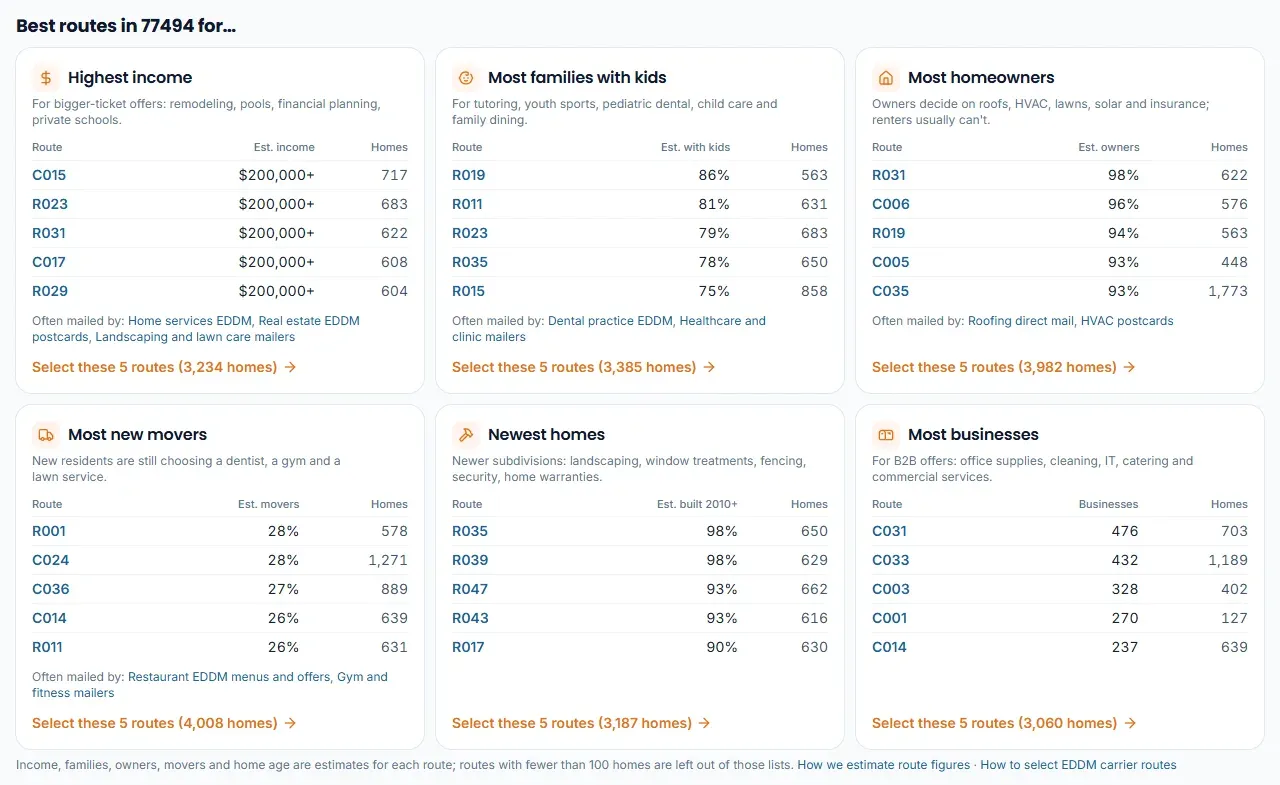
Same ZIP code, four different kinds of neighborhood. Mailing all 70 routes would cost the most and reach plenty of households in neither group. To find these routes in your own ZIP code, open its page on our ZIP code data site. The "Most families with kids" and "Most new movers" cards list the top routes, and each card can select its routes on the map for you. Route-level estimates cover Texas ZIP codes today; elsewhere you'll see the USPS home and business counts for every route.
Can a tool pick the routes for you?
Yes. Our smart ZIP quote does the first pass: enter your office's ZIP code and choose Dental, and it suggests the routes, shows who lives on them and prices the mailing. It's free and needs no account. Pick "Families with kids" or "Everyone nearby" to steer the picks.
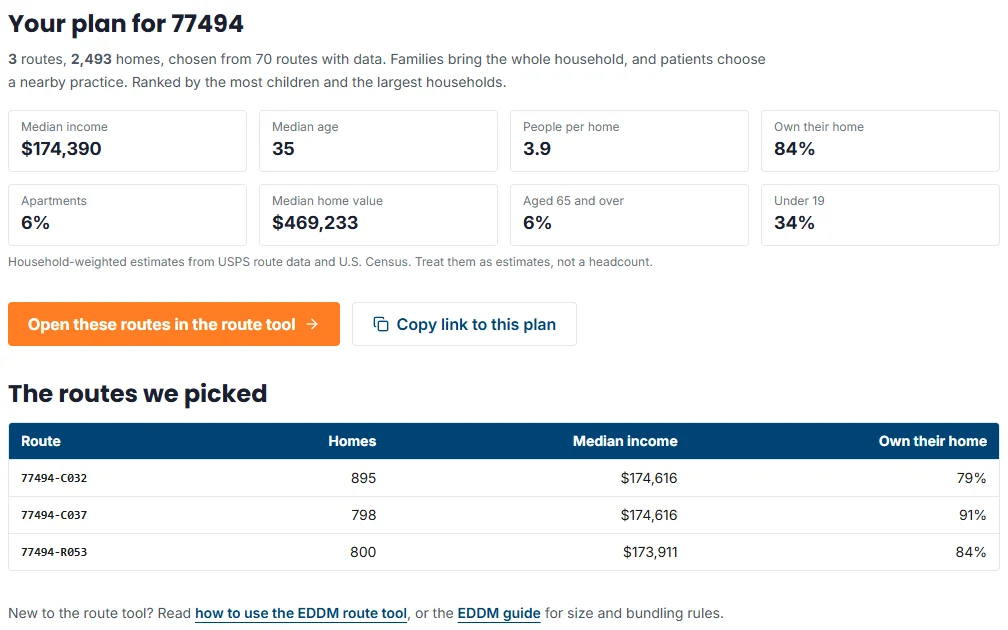
Its plan opens straight into the route map, where you can add or remove routes before you order.
How many routes should a dental office start with?
Start with three to five routes, which is roughly 2,000 to 3,500 cards. A typical carrier route has 500 to 800 homes, so that's a sensible first test for one office. Pick the closest routes that score well, then mail the same routes more than once. Repeat cards give your name the chance to feel familiar.
As a price guide, 2,500 6.5 x 9 postcards with EDDM Full Service are about $1,470 with USPS postage included, roughly 59 cents a card (our prices on October 25, 2026). Sales tax is added at checkout; USPS postage is never taxed. Your exact total depends on the routes you pick, because the routes set the count.
What goes on a new-patient postcard?
A new-patient postcard needs one clear offer, the insurance you take, a friendly face and an easy way to book. Here's what each part does:
- One clear offer, such as a new-patient exam and X-rays at a set price, or a free first visit for young children.
- The insurance you take. It's the first question most new patients ask.
- A photo of the dentist, so the first visit feels less like meeting a stranger.
- A QR code to your booking page and a phone number big enough to read from arm's length.
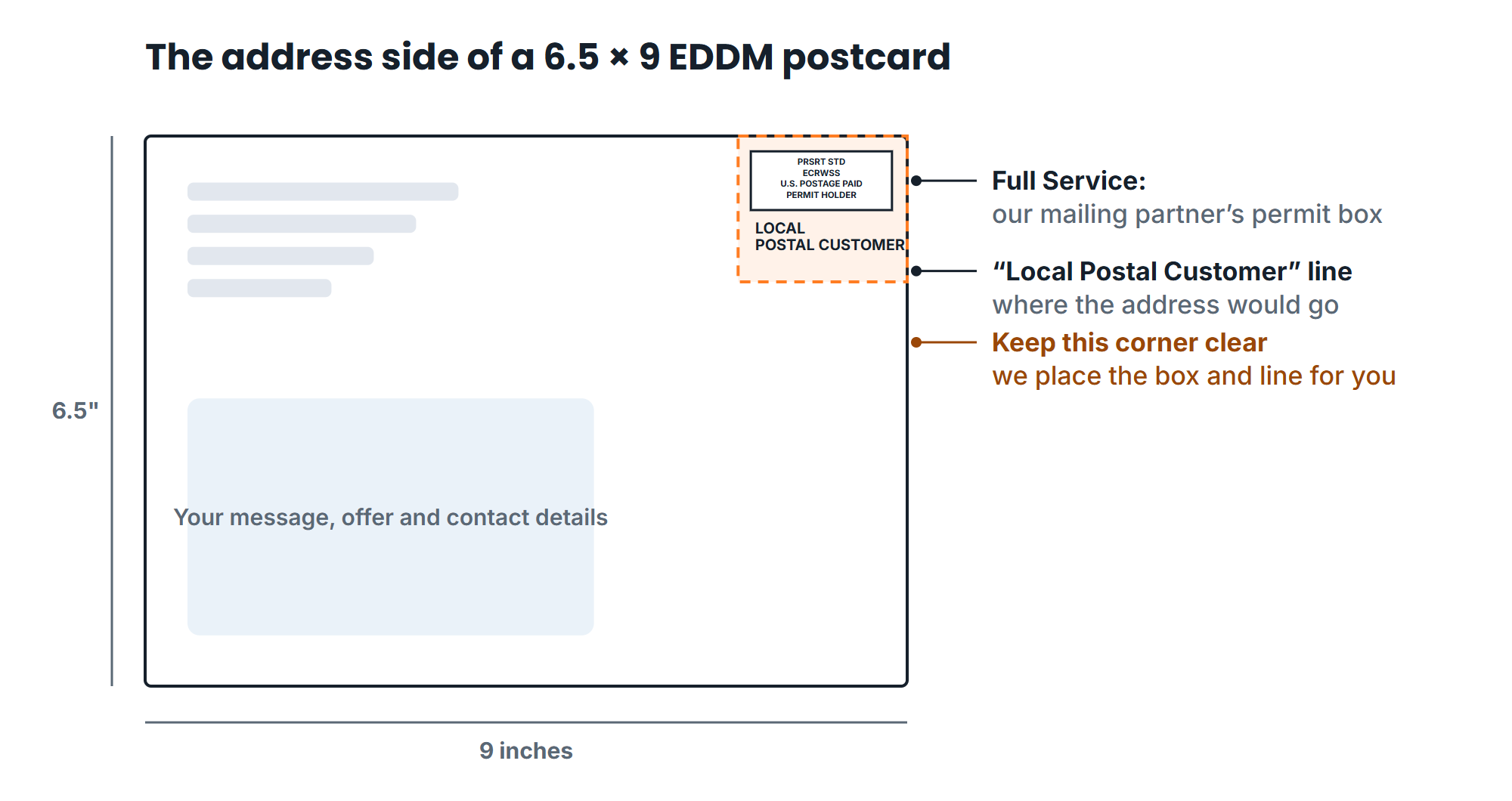
Dental advertising is regulated by state boards, and offers like discounted exams have rules in some states. Our dental practice guide covers compliant copy, offers and the break-even math. Our free EDDM templates keep your design clear of the postage area.
How do you know if the mailing worked?
Give each mailing its own phone number, QR code or offer code. Then you can count the calls and bookings it brought in and work out a cost per new patient. If you can't tell whether it worked, the campaign isn't finished. Nobody can promise you a response rate, including us, so measure your own.
Frequently asked questions
Can I mail only new movers?
Not with EDDM. EDDM mails every address on a route, so you choose routes where new movers are common. If you want only new movers, that's an addressed mailing from a list. We quote targeted mail by phone or email.
Are the route numbers exact?
The home and business counts come from USPS. Families with kids, new movers and homeowners are estimates we model from Census data. They're good for comparing routes, not facts about a household.
Should a dental office skip apartment routes?
Usually not. Renters need a dentist too, and apartment routes often have the most new movers. Skip them only if your offer only makes sense for homeowners.
How often should a practice mail?
Mail the same routes more than once. A mailing every few weeks or every quarter, with the offer rotated, makes the name familiar without repeating the same card.
Does EDDM use patient data?
No. EDDM pieces are addressed to "Postal Customer," so no names or patient information go on the mail.
Running more than one office? Our guide to direct mail for multi-location dental practices covers splitting routes and budgets between locations.
Start with your own neighborhood: look up your office's ZIP code, find the routes with the most families and new movers, and see the homes on those routes and the price, free, before you give us any contact details. Questions? Call (346) 306-EDDM (3336).