Dental, chiropractic and physical therapy practices use EDDM (Every Door Direct Mail) to put a new-patient offer in every mailbox near the office, with no mailing list. At the time of writing, 5,000 6.5 x 9 postcards with Full Service cost $2,643.17 before sales tax, postage included. This guide covers routes, offers, compliant copy and the math.
Why EDDM fits a local practice
Most people choose a dentist, chiropractor or therapist close to home or work, so a practice's market is a map, not a list. EDDM mails every address on the carrier routes you choose (a carrier route is the path one mail carrier covers each day). That reaches families who just moved in, people who have been putting off a visit, and neighbors who drive past the office without noticing it.
A new patient is usually worth far more than one appointment, because patients come back for cleanings, a care plan or a series of visits. That is why this guide focuses on break-even arithmetic you run with your own numbers, not on promised results.
Which routes should a practice mail?
- Closest routes first. Start with the neighborhoods patients can reach in a short drive, then widen.
- Family routes for family and pediatric dentistry. Routes that are mostly single-family homes usually mean more potential patients per address.
- Active neighborhoods for PT and sports chiropractic. Routes near parks, fields and gyms suit sports-injury messages.
- Established neighborhoods for balance and joint care. Routes with many long-time residents suit fall-prevention and arthritis messages.
- New construction. New arrivals need a new dentist. EDDM can't single them out, but it reaches every new resident on the routes you mail.
The route map shows the homes and businesses on every route and the all-in price as you click, before you give any contact details.
Offers that work on a mailbox
These are offer types, not results. Test one at a time so you know which one worked.
| Offer | Best for |
|---|---|
| New-patient exam and X-rays at a set price | General and family dentistry |
| Free consultation for clear aligners or orthodontics | Orthodontics, cosmetic dentistry |
| Free first visit for young children | Pediatric dentistry |
| New-patient exam and consultation at a set price | Chiropractic |
| Free movement assessment | Physical therapy, sports medicine |
Condition-specific headlines give a reader a reason to act that generic "chiropractic care" does not: "Back pain keeping you off the course?" or "Recovering from surgery? Specialized PT can help" (example copy). For dentistry, "Now welcoming new patients" plus the insurance networks you take answers the first two questions people ask.
What to put on the card
- A photo of the dentist or clinician, so the first visit feels familiar.
- Insurance accepted. List the networks you take.
- Conditions treated or services offered, in plain words people recognize themselves in.
- Your real review rating, stated exactly as it appears on the review site.
- A booking QR code straight to your scheduling page, plus a phone number.
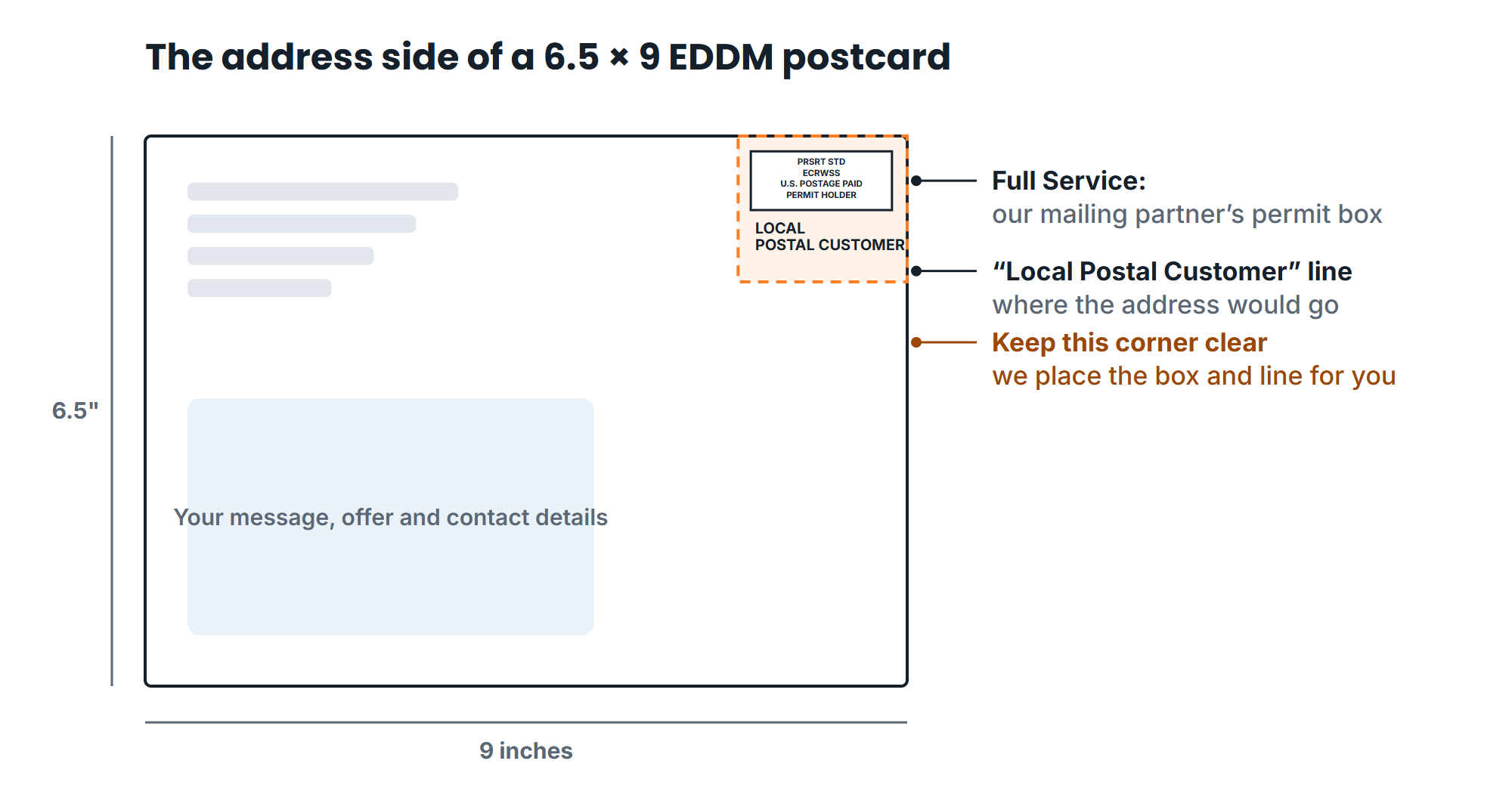
The back of the card also carries the postage box and the "Postal Customer" line, so keep that panel clear. Our free EDDM templates already mark it, and the free file checker flags problems before you order. If you'd rather hand the design off, our design service is a flat $125.
Compliant copy for healthcare marketing
Dental, chiropractic and physical therapy advertising is regulated by state licensing boards, and the rules differ by state. Before you print:
- Don't promise outcomes. "Painless" or "you'll be pain-free" can cause problems. Describe what you offer instead.
- Testimonials and before-and-after photos need written patient consent, and some states require disclosures.
- Specialty wording. Check your board's rules before calling yourself a specialist.
- Discounts and insurance. Check how your state treats discounted exams for insured patients.
When in doubt, have your state board's advertising rules and your compliance advisor review the draft.
What a practice mailing costs
Real prices at the time of writing, before sales tax. Full Service includes printing, bundling by carrier route, USPS paperwork, delivery to the Post Office and postage, shown as its own line.
| 6.5 x 9 postcard | Full Service | Print Only (printing only) |
|---|---|---|
| 2,500 pieces | $1,435.20 ($0.57 each) | $475.25 |
| 5,000 pieces | $2,643.17 ($0.53 each) | $688.36 |
8.25% sales tax is added at checkout on everything except USPS postage, in every state. With Print Only you get the printing; you then pay USPS $0.26 a piece at the Post Office, plus shipping, and bundle the cards yourself. Today's figures are on the 6.5 x 9 Full Service page.
Break-even math (hypothetical)
This is arithmetic, not a forecast. Plug in your own numbers.
- Campaign: 5,000 6.5 x 9 postcards, Full Service: $2,643.17, plus $107.59 sales tax (8.25% on everything except the USPS postage line) = $2,750.76 all-in.
- If a new dental patient brings $650 in first-year revenue (use your own figure): $2,750.76 ÷ $650 = about 4.2, so 5 new patients cover the mailing. That is 1 patient in every 1,000 households.
- A smaller clinic mailing 2,500 cards at $1,435.20 before tax, where a new patient is worth $500 to the practice (hypothetical): $1,435.20 ÷ $500 = 2.9, so 3 new patients cover it.
When and how often to mail
- January: many patients start a new benefits year, and new-year health goals bring people in.
- Spring: activity picks up, which suits sports-injury and PT messages.
- Late summer: back-to-school checkups and back-to-routine visits.
- Fall: "Use your benefits before they reset" (check how your patients' plans work).
One mailing builds awareness; repeated mailings to the same routes build recognition. Many practices mail quarterly and rotate the offer. USPS does not guarantee EDDM delivery dates, so plan each mailing with a buffer before the month you want to promote, and track it with its own phone number or code.
When EDDM is the wrong tool: if your practice is referral-only, or you want to reach one group of people (lapsed patients, new movers, one employer's staff), an addressed mailing list wastes less than mailing every door. Some practices run both: EDDM for the neighborhood, a list for their own patients.
Frequently asked questions
How much does dental direct mail cost with EDDM?
At the time of writing, 5,000 6.5 x 9 postcards with Full Service cost $2,643.17 before tax, and 2,500 cost $1,435.20, with postage included. Sales tax is added at checkout on everything except USPS postage. Current prices for every size are on the pricing page.
Is EDDM HIPAA-safe for a healthcare practice?
EDDM mail is addressed to "Postal Customer" and uses no patient data, so you are not mailing protected health information. Keep testimonials and patient photos to those with written consent.
Can EDDM target only new movers?
No. EDDM mails every address on a route. It reaches new movers on those routes along with everyone else. A new-mover list is the tool for person-level targeting.
Can I advertise a discounted first visit?
Often yes, but insurance rules and state board rules vary. Check with your state board before you print an exam discount.
How many postcards should a practice start with?
Many start with 2,500 to 5,000 pieces on the routes closest to the office, then mail the same routes again before judging the results.
Next step: see the homes on your routes and the price, free. Saving a route list earns the welcome credit: create an account, confirm your email and save a route list; it applies automatically to a first paid order within 60 days: $25 off, or $50 off at $500 or more (before tax and USPS postage). More ideas are on our dental and healthcare EDDM pages. Questions? Call (346) 306-EDDM (3336).